
The respiratory care ward (RCW): preparing and deciding, before and after the transfer
Division of Pulmonary Medicine, Taipei Veterans General Hospital Hsinchu Branch · Respiratory care health information
After the winter, a good many people who have gone into respiratory failure from pneumonia cannot, for one reason or another, be weaned off the ventilator. Dr. Chiu often meets anxious families in his clinic who arrive with the medical records and ask: “Doctor, the intensive care doctors say our ‘time is up’ and we have to move to a respiratory care centre or a respiratory care ward.”
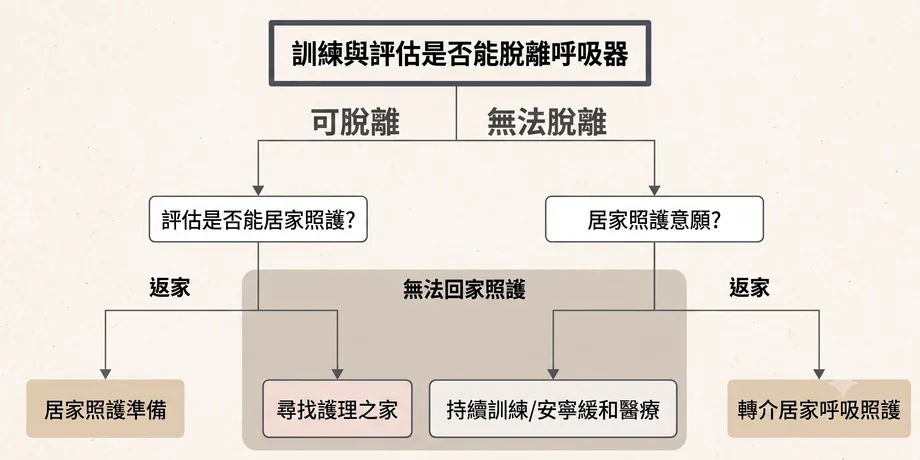
In fact “the time is up, so you have to move out” is a common misunderstanding. What really determines whether someone can leave intensive care is how stable their condition is (the details are in the National Health Insurance (NHI) “prospective payment programme for integrated care of ventilator-dependent patients”). What happens next is then shaped by the goals of treatment — wanting to keep fighting on, and wanting a course of care that makes the leaving comfortable, are two quite different things. Dr. Chiu has gathered years of experience into “preparing for the transfer to an RCW” and “the major decision points after the transfer”, for families to use as a guide.
Preparing for the transfer to an RCW
| Step | Where | What is involved |
|---|---|---|
| 1 | The original hospital | A summary of the medical record, and the imaging on disc |
| 2 | The chest medicine outpatient clinic | A consultation and discussion (self-paid; you need to register for the clinic, but no NHI card is needed) *Note 1: 1. Consultation on the future goals of treatment 2. Consultation on tracheostomy and palliative care 3. Consultation on what rehabilitation would involve 4. An explanation of the National Health Insurance (NHI) coverage rules |
| 3 | The RCW ward | 1. A look round the ward 2. An explanation of the charges |
| 4 | Transfer into the RCW ward | 1. We contact the original hospital to confirm whether the pre-transfer tests have been completed 2. Once the date is settled, you arrange the ambulance transfer yourselves 3. The family brings the patient’s usual personal things 4. The family is taught rehabilitation techniques (depending on the patient’s condition) 5. A referral for traditional Chinese medicine acupuncture (whether the NHI covers this depends on the patient’s condition) |
The major decision points after the transfer
Once the patient has transferred, the medical team keeps assessing — in the light of the patient’s condition and the goals of treatment the family has set — whether coming off the ventilator is possible, what rehabilitation is needed, and other important decisions such as whether to move to palliative care. There are no standard answers to these choices; talk them through fully with the team looking after the patient, and decide together, in the patient’s best interests and according to their wishes.
An important idea
What someone’s move out of intensive care turns on is “how stable their condition is”, not “how many days they have been in hospital”. Whether to go on with active treatment or to change to comfort care depends on the goals of treatment that have been set, and the two point care in quite different directions.
*Note 1: under Article 7 of the Regulations for Medical Care under National Health Insurance, where the person attending is not the patient themselves and the patient is not a chronic disease patient, the visit does not fall within the scope of National Health Insurance cover; the associated fee is charged instead under the Hsinchu County approved schedule of self-paid medical items and charges for medical institutions — common items category, d03, the fee for a consultation about a patient’s condition.

The original health education leaflet
You can view it online or download the A4 version to print and share.
References
- 衛生福利部中央健康保險署. 全民健康保險呼吸器依賴患者整合性照護前瞻性支付方案(IDS). Available from: https://www.nhi.gov.tw [In English: Central National Health Insurance Administration, Ministry of Health and Welfare. National Health Insurance prospective payment programme for the integrated delivery system (IDS) for ventilator-dependent patients.]
- 衛生福利部. 全民健康保險醫療辦法第 7 條. [In English: Ministry of Health and Welfare. Regulations for Medical Care under National Health Insurance, Article 7.]
References follow the ICMJE (Vancouver) style. Guidelines and official documents are given with their version or year of publication; legislation and National Health Insurance (NHI) rules are given with the responsible authority and the version date. Last checked: 8 October 2026.
This content is health information. It is for reference only and cannot replace a professional medical diagnosis or an individual medical decision. For the actual care and the actual costs, please ask the medical team. This site records only anonymous usage statistics (for example, how many people read a page to the end, how many complete a self-assessment, and which band the result falls into). It does not record what you answered, and it sets no cookies. See the privacy notice for details.
Still have questions? Add Dr. Hwa-Yen Chiu’s LINE official account @chiubreath for clinic news and updates on respiratory health.
Add on LINE