
Altitude sickness: what to read before you go up
Division of Pulmonary Medicine, Taipei Veterans General Hospital Hsinchu Branch · Altitude sickness health information
The well-known YouTubers Ray Du and Didi described how, on a trip to Mexico City (at an altitude of about 2400 metres), they had a headache, felt sick, lost their appetite and generally felt dreadful. If you have ever been up a mountain or visited somewhere at high altitude, those symptoms may be familiar — this is altitude sickness (high-altitude illness)!
What is altitude sickness?
Acute mountain sickness (AMS) is the body’s reaction to the sudden drop in the concentration of oxygen when you go up above 2500 metres in a short space of time. The common symptoms are headache, nausea, vomiting, loss of appetite, feeling weak all over, sleeplessness, dizziness and palpitations.
⚠ Danger signs
If it is not dealt with properly it can go on to become high-altitude cerebral oedema (HACE) or high-altitude pulmonary oedema (HAPE), which are life-threatening. If there is any change in consciousness, any unsteadiness of gait, or severe breathlessness even at rest, you must descend and get medical help immediately.
The keys to prevention
- Ascend slowly: raise your sleeping altitude by no more than 500 metres a night, and rest enough. Strong evidence
- Take plenty of fluids and a high-carbohydrate diet.
- Avoid strenuous exercise and alcohol.
- Use preventive medicines if you need to (see the table below).
| Medicine | Ingredient / brand name | Recommended dose | How it works | Side effects | How to use it | Evidence |
|---|---|---|---|---|---|---|
| Rhodiola root | Rhodiola | 200–400 mg/day orally | Antioxidant, anti-fatigue | Stomach upset | Start taking it 1 week before you set off | Limited |
| Diamox | Acetazolamide (Diamox)[1] | 125–250 mg, once in the morning and once in the evening | Metabolic acidosis → stimulates breathing | Tingling hands, a change in taste, passing more urine | Start 1–2 days before you set off | Strong evidence |
| A steroid | Dexamethasone[4] | 4 mg every 12 hours | Anti-inflammatory; stabilises the blood–brain barrier | Increased appetite, sleeplessness, mood swings | For those at seriously high risk, or who cannot take Diamox | Strong evidence |
The principles of treatment
There are three principles of treatment: stop ascending (and descend if you have to), give oxygen or use a portable pressurisation bag (a Gamow bag, for example), and start drug treatment at once.
| Symptoms | Medicine | Recommended dose | Main use | Side effects |
|---|---|---|---|---|
| Mild to moderate AMS | Acetazolamide[1] | 250 mg every 12 hours | Relieves the headache and helps breathing acclimatise | Tingling hands, passing more urine, a change in taste |
| Severe AMS / HACE | Dexamethasone[4] | 8 mg initially, then 4 mg every 6 hours | Counters cerebral oedema; improves neurological symptoms quickly | Sleeplessness, a rise in blood sugar, changes in mood |
| HAPE | Nifedipine[2] | 30 mg slow-release every 12 hours | Lowers the pulmonary artery pressure; prevents and treats HAPE | Low blood pressure, dizziness, a fast heartbeat |
| HAPE | Sildenafil (Viagra)[3] | 50 mg every 8 hours | Dilates the pulmonary blood vessels; improves oxygenation | A fall in blood pressure, headache, flushing, visual disturbance |
| HAPE | Tadalafil[4] | 10 mg every 12 hours | Dilates the pulmonary blood vessels; prevents HAPE | Headache, indigestion, aching muscles |
| Hypoxia | Oxygen therapy (a mask / a high-flow device) | Continuous oxygen, aiming for an SpO₂ > 90% | Resolves the symptoms of a lack of oxygen | A dry nose; and if you do not descend, there is still the risk of coming to depend on it |
The medicines and doses above are compiled from the high-altitude medicine literature and the Wilderness Medical Society clinical practice guidelines[1–4]; before you actually use any of them, consult a doctor and have the contraindications assessed in the light of your own medical history (glaucoma, allergy to sulfonamides, or taking nitrate medicines, for example).
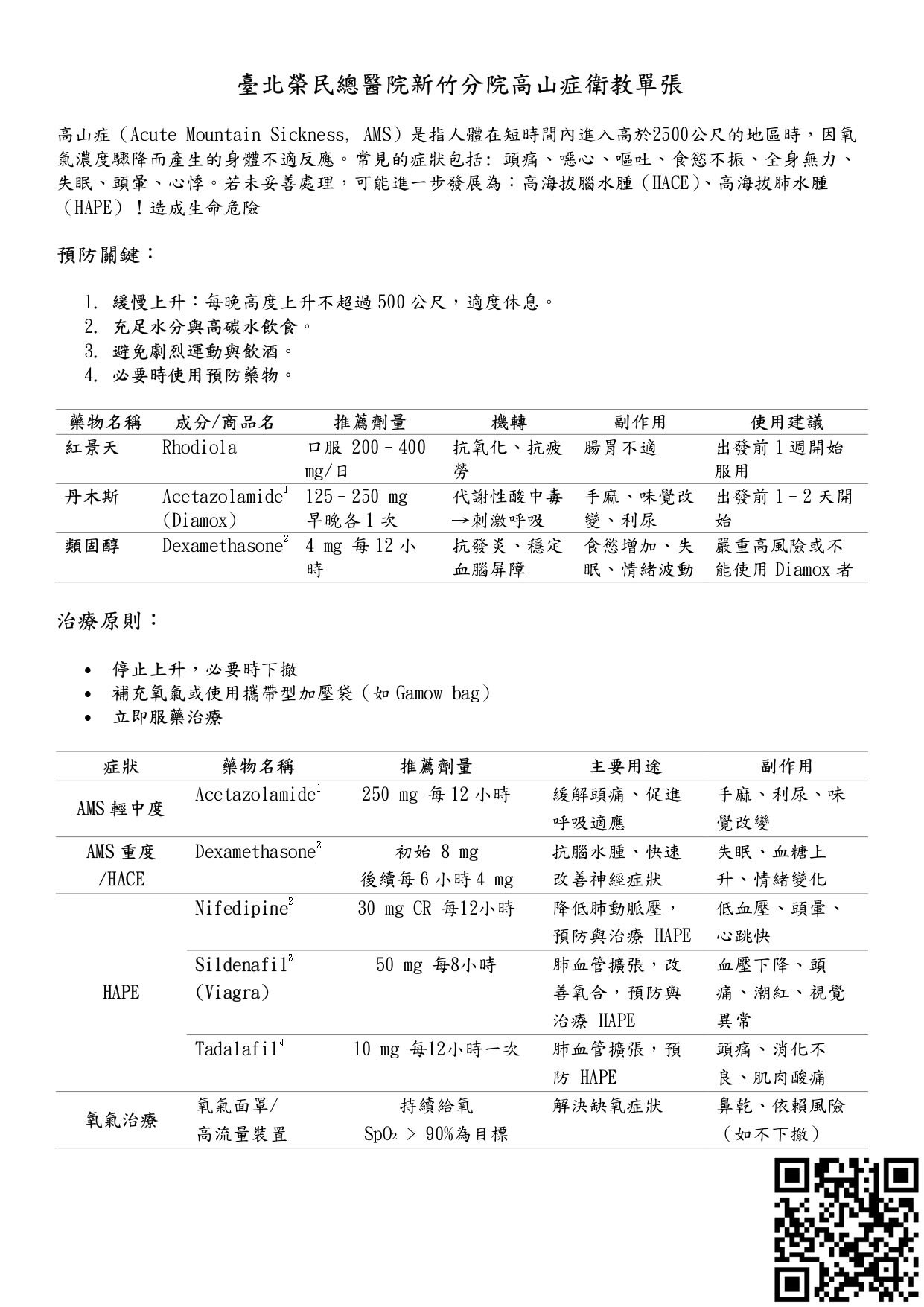
The original health education leaflet
You can view it online or download the A4 version to print and share.
References
- Luks AM, Auerbach PS, Freer L, et al. Wilderness Medical Society clinical practice guidelines for the prevention and treatment of acute altitude illness: 2019 update. Wilderness Environ Med. 2019;30(4S):S3-S18.
- Low EV, Avery AJ, Gupta V, et al. Identifying the lowest effective dose of acetazolamide for the prophylaxis of acute mountain sickness: systematic review and meta-analysis. BMJ. 2012;345:e6779.
- Bärtsch P, Maggiorini M, Ritter M, et al. Prevention of high-altitude pulmonary edema by nifedipine. N Engl J Med. 1991;325(18):1284-1289.
- Richalet JP, Gratadour P, Robach P, et al. Sildenafil inhibits altitude-induced hypoxemia and pulmonary hypertension. Am J Respir Crit Care Med. 2005;171(3):275-281.
References follow the ICMJE (Vancouver) style. Guidelines and official documents are given with their version or year of publication; legislation and National Health Insurance (NHI) rules are given with the responsible authority and the version date. Last checked: 8 October 2026.
This content is health information. It is for reference only and cannot replace a professional medical diagnosis. Before taking any of these medicines — and especially before taking anything preventively — please consult a qualified physician, who will assess your own contraindications and whether it is indicated for you. This site records only anonymous usage statistics (for example, how many people read a page to the end, how many complete a self-assessment, and which band the result falls into). It does not record what you answered, and it sets no cookies. See the privacy notice for details.
Still have questions? Add Dr. Hwa-Yen Chiu’s LINE official account @chiubreath for clinic news and updates on respiratory health.
Add on LINE