
Low-dose CT (LDCT) lung cancer screening: do not panic when you see a lung nodule
Division of Pulmonary Medicine, Taipei Veterans General Hospital Hsinchu Branch · Lung cancer screening health information
For healthcare professionalsClinical pathway: LDCT eligibility calculator (中文)
Ms. Lin, 52, has a family history of lung cancer. Two years ago she had an LDCT scan under the Health Promotion Administration’s subsidised programme, and the report found “a 4 mm solid nodule”. The moment she saw the word “nodule” her mind went blank; she pushed the report into a drawer and did not dare set foot in a hospital for two whole years. Recently a cold left her with a cough that would not settle, and the fear came back: “Has that nodule from two years ago grown?” She finally found the courage to bring the old report to Dr. Chiu’s clinic.
Dr. Chiu read it through carefully and explained: “Under Lung-RADS v2022, the reporting guideline used internationally, a solid nodule smaller than 6 mm found at baseline screening is ‘category 2 (benign)’. The great majority are scars left by old inflammation or infection in the lung, the chance of malignancy is extremely low, and the standard advice is simply to keep following it up.” He then arranged a new LDCT and compared the new and old images side by side — the nodule was still 4 mm, with no change at all in shape or size. “In medicine a nodule only counts as having ‘grown’ if its mean diameter increases by more than 1.5 mm within 12 months. Yours has not budged in two years, which confirms it is a stable, benign scar. The recent cough is just acute bronchitis; it has nothing to do with the nodule.” The weight that had sat on her chest for two years was finally lifted.
Why have lung cancer screening?
Lung cancer is the leading cause of cancer death in Taiwan, but if it can be found early, at stage 1, the 5-year survival is over 90%. Low-dose computed tomography (LDCT) is at present the only screening tool that large trials have shown to reduce death from lung cancer[3]. The scan itself takes about 5 minutes, needs no contrast injection and is painless. Strong evidence
Just as worth knowing: screening for lung cancer with a chest X-ray does not reduce death from lung cancer, and large trials have established this. Insufficient So “an X-ray at the annual health check” is no substitute for LDCT; but a chest X-ray is still an important first-line test when you have symptoms.
Eligibility for the government-funded LDCT screening programme
To look after people at high risk, the Health Promotion Administration of the Ministry of Health and Welfare has widened lung cancer screening from 2025 (ROC year 114). Anyone meeting either of the conditions below is offered one free LDCT every 2 years[1]:
| Risk group | Men | Women | Notes |
|---|---|---|---|
| Family history of lung cancer | 45–74 years | 40–74 years | A parent, child or sibling (a blood relative) has had a confirmed diagnosis of lung cancer |
| Heavy smokers | 50–74 years | 50–74 years | A smoking history of 20 pack-years or more (for example 1 pack a day for 20 years), and still smoking, or having stopped less than 15 years ago |
Source: Health Promotion Administration, Ministry of Health and Welfare, “expanded lung cancer screening service” (from 2025, ROC year 114)[1]. Note: for smokers, the smoking-cessation package is a condition of enrolment — the consent form states that “if I currently smoke, I agree to accept smoking-cessation counselling”, and the service cannot be provided to anyone who has not signed the consent form. So anyone who still smokes has to agree to accept smoking-cessation counselling in order to have the free screening, and anyone who has already stopped should stay stopped. LDCT can only find lung cancer early; it cannot prevent it, and screening is no substitute for stopping smoking.
What should you do if you are told you have a “lung nodule”?
There is no need to be alarmed when you see “lung nodule” on a report — as many as 95% of the lung nodules picked up by LDCT screening are benign. Your doctor will draw up a follow-up plan for you according to the American College of Radiology’s Lung-RADS v2022 reporting guideline[2], together with the funding rules of Taiwan’s Health Promotion Administration:
| Nodule type and size | Lung-RADS | ACR recommended management | Health Promotion Administration (Taiwan) recommendation |
|---|---|---|---|
| A single solid nodule | |||
| < 6 mm | 2 | LDCT follow-up in 12 months | Government-funded screening again in 2 years |
| 6 to < 8 mm | 3 | LDCT follow-up in 6 months | Follow-up in 6 months |
| 8 to < 15 mm | 4A | LDCT in 3 months | Follow-up or further investigation in 3 months |
| ≥ 15 mm | 4B | Diagnostic chest CT / tissue sampling | Arrange a diagnostic procedure (such as a biopsy) |
| A single part-solid nodule | |||
| Total diameter < 6 mm | 2 | LDCT follow-up in 12 months | Government-funded screening again in 2 years |
| Solid component < 6 mm | 3 | LDCT follow-up in 6 months | Follow-up in 6 months |
| Solid component 6 to < 8 mm | 4A | LDCT in 3 months | Follow-up or further investigation in 3 months |
| Solid component ≥ 8 mm | 4B | Diagnostic chest CT / tissue sampling | Arrange a diagnostic procedure (such as a biopsy) |
| A single ground-glass nodule | |||
| < 30 mm | 2 | LDCT follow-up in 12 months | Government-funded screening again in 2 years |
| ≥ 30 mm | 3 | LDCT follow-up in 6 months | Follow-up in 6 months |
| Doubles in size within 1 year | 4X | Treated as highly suspicious | Arrange a diagnostic procedure |
| Multiple nodules | |||
| Several nodules differing in size and type | By the most suspicious nodule | Go by the nodule that is most strongly suspected | Go by the category of the most worrying nodule |
| Several new nodules over a short period (> 6), suspected infection / inflammation | 0 | LDCT follow-up in 1–3 months | Come back to the outpatient clinic for advice, where treatment or short-interval follow-up will be assessed |
Sources: American College of Radiology, Lung-RADS® v2022[2]; the Taiwan management column is compiled from the Health Promotion Administration’s government-funded resources and the National Health Insurance (NHI) rules. For a normal result or a benign nodule (categories 1 and 2), the Health Promotion Administration funds screening once every 2 years; cases in categories 3 and 4, where something suspicious has been found, return to the NHI medical system, where a chest physician arranges the follow-up and the work-up to reach a diagnosis.
What “the nodule has grown” actually means
A nodule’s mean diameter has to increase by more than 1.5 mm within 12 months before it meets the medical definition of having “grown”. A small nodule that stays unchanged is in the great majority of cases a benign scar; following it up at the intervals the guideline sets out is enough, and neither surgery nor a biopsy is needed straight away.
Interactive version
If you want to know whether you qualify for the government-funded programme, or to look up the Lung-RADS category on your report, you can use the interactive version:
① Lung cancer risk assessment and LDCT government-funding eligibility calculator (中文)— enter your family history, smoking history and exposure to cooking fumes; it estimates your risk using the TALENT study and works out whether you are eligible for the Health Promotion Administration’s funding.
② Follow-up guidance after your report (中文)— enter the Lung-RADS category, or the size and type of the nodule, and you will get the follow-up interval, how the follow-up should be done and what should happen next.
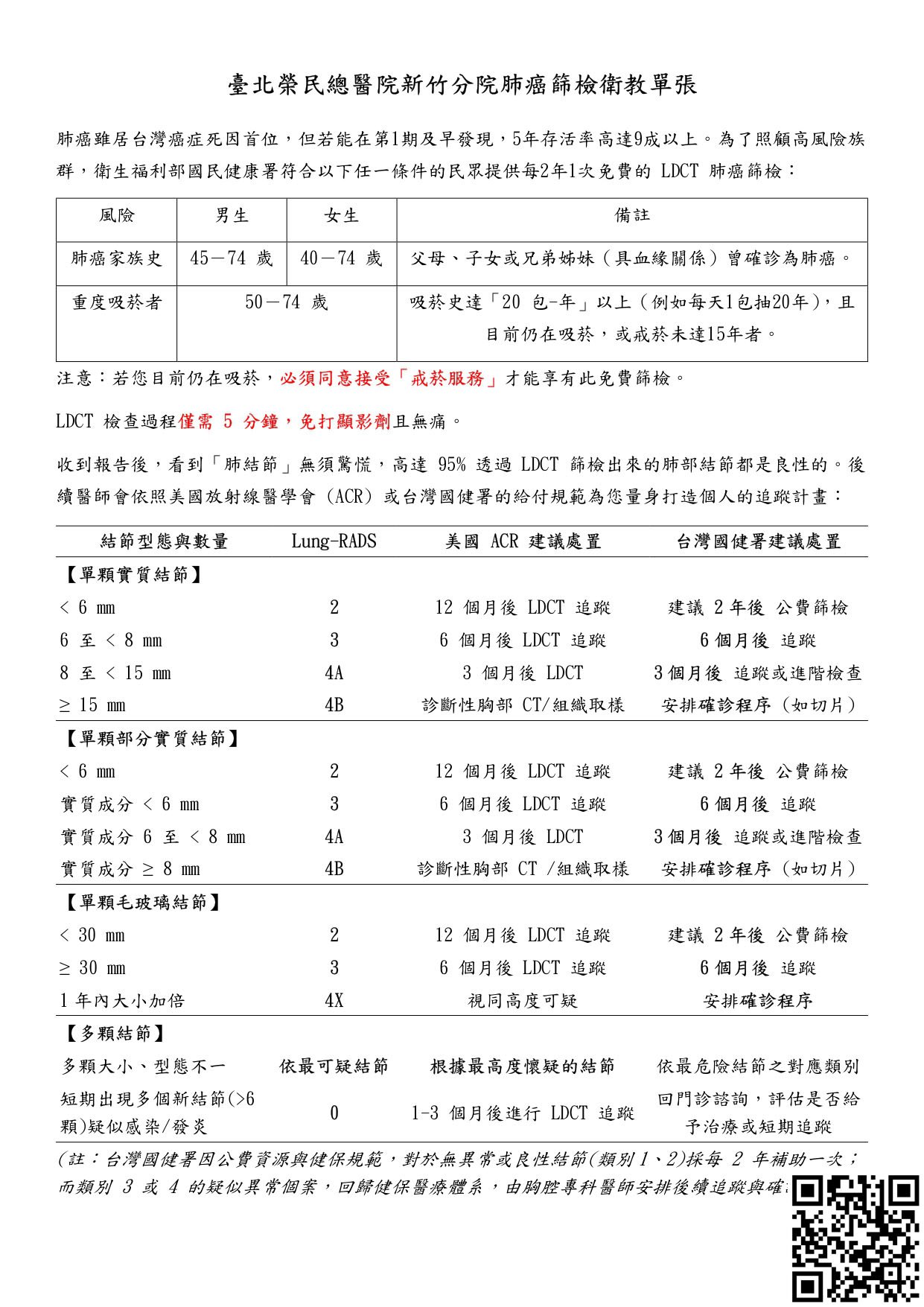
The original health education leaflet
You can view it online or download the A4 version to print and share.
References
- 衛生福利部國民健康署. 胸部低劑量電腦斷層檢查服務(115 年 1 月 1 日版). 臺北:國民健康署. Available from: https://www.hpa.gov.tw [In English: Health Promotion Administration, Ministry of Health and Welfare. Low-dose computed tomography of the chest screening service (version of 1 January 2026). Taipei: Health Promotion Administration.]
- Christensen J, Prosper AE, Wu CC, et al. ACR Lung-RADS v2022: assessment categories and management recommendations. J Am Coll Radiol. 2024;21(3):473-488. Available from: https://www.acr.org
- National Lung Screening Trial Research Team. Reduced lung-cancer mortality with low-dose computed tomographic screening. N Engl J Med. 2011;365(5):395-409.
References follow the ICMJE (Vancouver) style. Guidelines and official documents are given with their version or year of publication; legislation and National Health Insurance (NHI) rules are given with the responsible authority and the version date. Last checked: 8 October 2026.
This content is health information. It is for reference only and cannot replace a professional medical diagnosis. For the actual reading of your scan and your follow-up plan, please consult a chest physician. This site records only anonymous usage statistics (for example, how many people read a page to the end, how many complete a self-assessment, and which band the result falls into). It does not record what you answered, and it sets no cookies. See the privacy notice for details.
Still have questions? Add Dr. Hwa-Yen Chiu’s LINE official account @chiubreath for clinic news and updates on respiratory health.
Add on LINE