
External counterpulsation (EECP): a road for angina patients with “nothing left to operate on”
Division of Pulmonary Medicine, Taipei Veterans General Hospital Hsinchu Branch · Wellness treatments
Related pagesWellness treatments overviewClinical pathway: heart failure (中文)
A man of 74 had disease in all three coronary arteries. He had had two cardiac catheterisations, four stents put in, and bypass surgery as well. The vessels that were left would now neither take a stent nor carry a graft — both the cardiac surgeons and the cardiologists said everything that could be done had been done.
But he could not walk a hundred metres without his chest tightening, and even going to the corner shop for breakfast meant stopping to put a tablet under his tongue. His medication had already been pushed to the limit his blood pressure would tolerate.
There is a name in medicine for this situation: refractory angina — the drugs have been optimised, revascularisation has been done, and the symptoms still limit life. External counterpulsation is the treatment designed for exactly these people. It is not maintenance and it is not wellness; it is a road that is still open after “there is nothing left to operate on”.
What is EECP doing?
The principle of enhanced external counterpulsation can be thought of as using a machine to give the heart a beat in the opposite direction.
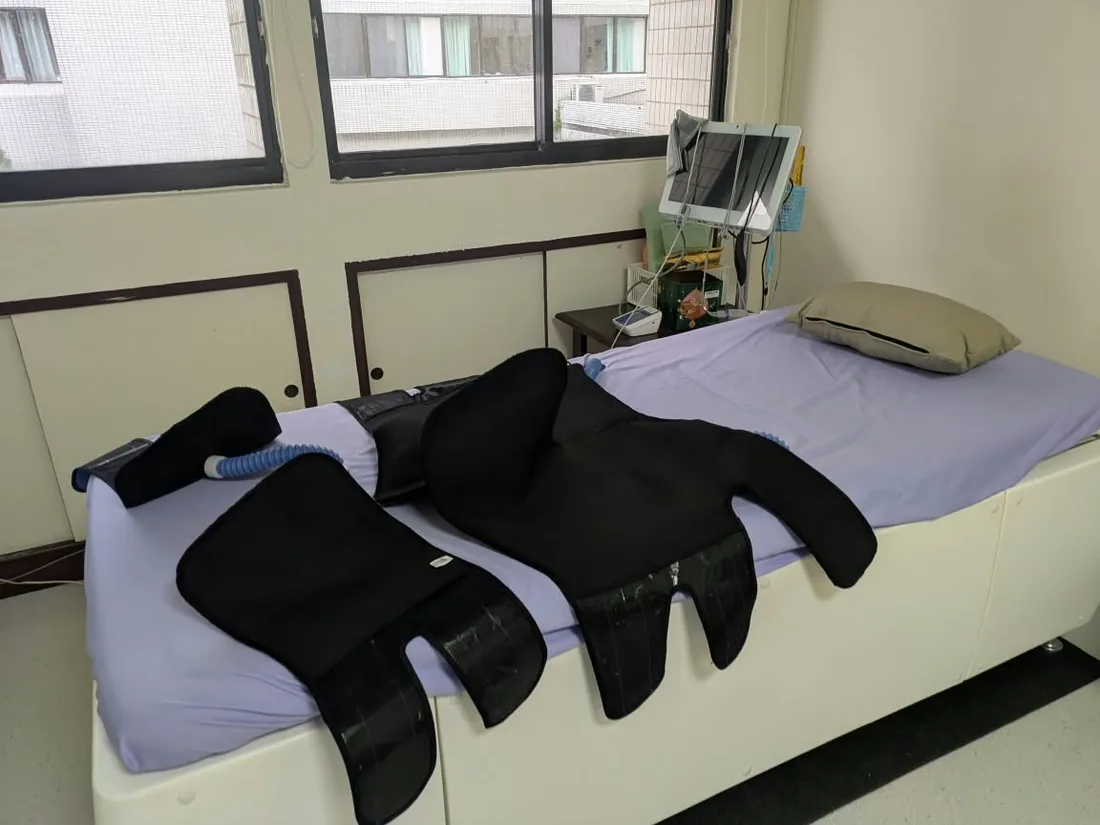
During treatment, three sets of air-pressure cuffs are wrapped round the patient’s calves, thighs and buttocks. The machine is connected to the ECG, so that it catches the timing of the heartbeat precisely:
- While the heart is relaxing (the moment at which the heart muscle is being perfused), the three sets of cuffs inflate and squeeze rapidly in sequence from the bottom upwards, pushing the blood in the legs back towards the heart and raising the diastolic pressure in the aorta — and since the coronary arteries only have blood flowing through them in diastole, that squeeze amounts to pushing more blood into the heart muscle.
- In the instant before the heart is about to contract, the cuffs all deflate at once, so that the vessels in the legs suddenly become “empty”. The resistance against which the heart has to eject falls (the afterload is lowered), and the heart’s work actually becomes easier.
This squeeze and release repeats with the heartbeat seventy or eighty times a minute, for an hour at a stretch. Its effect is not only during that hour: the repeated high-velocity blood flow keeps stimulating the lining of the blood vessels, and is thought to improve endothelial function and encourage collateral circulation to develop — which is where the phrase “natural bypass” comes from.
For whom is there really evidence?
Where the evidence is strongest: chronic stable and refractory angina
The key randomised controlled trial is MUST-EECP, which used the standard 35-hour course and showed that EECP helps in chronic stable angina: the time spent exercising before angina came on lengthened, and attacks of angina became less frequent. The US FDA approved this use on that basis.
In practice the people best suited to it are those who are already on optimal drug treatment, and in whom revascularisation (stent or bypass) has been done, cannot be done, or is not wanted, and whose symptoms still clearly limit their life.
| Use | State of the evidence | How to read it |
|---|---|---|
| Chronic stable or refractory angina | The MUST-EECP randomised controlled trial; FDA approved | Supported by evidence |
| Mild to moderate heart failure (NYHA II–III) | The PEECH trial: an increase in exercise time of more than 60 seconds in 35% vs 25%, but no improvement in peak oxygen uptake | Limited benefit |
| Acute myocardial infarction, cardiogenic shock | Covered by the device approval, but the clinical benefit is unproven | Not a routine use |
| Rehabilitation after stroke, erectile function, diabetes, kidney disease | Small or exploratory studies | Not yet settled |
| “Circulation maintenance” and anti-ageing in healthy people | — | No indication |
There is one more thing particularly worth remembering: there is at present no evidence that extending the course beyond 35 sessions brings any additional benefit. If someone suggests you “add another block”, ask them to explain why.
How is a course run?
| Item | Standard practice |
|---|---|
| Total hours | 35 hours (this is the dose the trials validated) |
| Usual schedule | 1 hour per session, 5 days a week × 7 weeks |
| Accelerated schedule | Twice a day (with at least 30 minutes between), finishing in about 3.5 weeks |
| What it feels like during treatment | The legs are squeezed firmly and rhythmically, rather as if someone were hugging your calves and thighs in time. Most people get used to it after a few sessions, and can talk, listen to music or watch something |
| What to prepare | Wear close-fitting stretchy trousers (to avoid chafing the skin), do not eat too much in the hour before treatment, and go to the lavatory first |
During the course you should carry on taking your usual heart medication. EECP is not there to replace the drugs; it is a layer added on top of them.
Contraindications: please read this section right through
EECP is itself very safe, but there is an explicit list of contraindications. It pushes a large volume of blood from the legs back towards the heart and the aorta, so anything that means “the aorta cannot take extra pressure” or “the blood must not be driven hard” has to be ruled out:
| Category | Must not be done (or has to be dealt with first) |
|---|---|
| Aorta | Abdominal aortic aneurysm (where it is enlarging), aortic dissection |
| Valves | Moderate or worse aortic regurgitation — counterpulsation pushes more blood back into the left ventricle, making the regurgitation worse |
| Acute cardiac events | Myocardial infarction within the past 3 months, unstable angina, decompensated heart failure |
| Rhythm | Uncontrolled arrhythmia; a heart rate < 35 or > 125 beats/min (the machine cannot catch diastole accurately) |
| Blood pressure | Severe uncontrolled hypertension (> 180/110 mmHg) |
| Clotting | INR > 2.0, or a tendency to bleed |
| Blood vessels | Deep vein thrombosis (DVT), severe peripheral arterial disease, phlebitis, ulceration or infection of the legs |
| Other | Pregnancy; cardiac catheterisation within the past 1–2 weeks (where the puncture site has not yet healed) |
Common side effects
The commonest is discomfort in the legs — aching and a feeling of fullness in the thighs or calves, redness where the skin has been rubbed, and in a few people blisters (usually to do with trousers that are not close-fitting enough, or cuffs that are too loose). Others include tiredness after treatment, and dizziness in a few people. Overall EECP is well tolerated, and serious complications are rare.
Common questions
Can this replace cardiac catheterisation or bypass surgery?
No. If a vessel is narrowed enough for there to be an indication for revascularisation, revascularisation should be done first. The place of EECP is this: as the next step when everything that should be done has been done, or genuinely cannot be done, and the symptoms still limit life. Doing it the other way round delays the treatment that really ought to happen.
Why does it have to be 35 sessions? Can I have fewer?
Thirty-five hours is the “dose” the clinical trials validated, and the effect of doing less is uncertain. Put the other way round, there is also no evidence at present that going beyond 35 sessions is better. So the figure of 35 deserves to be taken seriously: do not give up early, and do not be talked into extending it indefinitely.
Does it hurt while it is being done?
It is not pain, it is “a very firm, regular squeezing”. The first session is usually the one you are least used to; most people can relax after two or three and chat or watch something. Wearing close-fitting stretchy trousers noticeably reduces the discomfort of the skin being rubbed. If you get pain in one place, or the skin breaks, tell the therapist at once so the pressure and the position of the cuffs can be adjusted.
How long does the effect last?
The trials show that the improvement in symptoms after finishing a course can last from several months to more than a year, and it varies a great deal between individuals. Because the mechanism involves endothelial function and collateral circulation, the effect usually appears gradually rather than everything being different on the day you finish. It is common to notice nothing until the middle or later part of the course.
Does the NHI cover it?
In Taiwan it is at present self-paid. Before arranging it, do confirm the total cost of the complete course (35 sessions is a considerable outlay), and check with your doctor that you really do meet the indication and have no contraindication, before deciding.
I have no heart disease. Can I have it to “look after my circulation”?
EECP has no indication for “wellness”, and there is no known benefit in a healthy person having it. The more practical advice is this: regular aerobic exercise improves endothelial function and collateral circulation in itself — and it is free.
References
- Arora RR, Chou TM, Jain D, et al. The multicenter study of enhanced external counterpulsation (MUST-EECP): effect of EECP on exercise-induced myocardial ischemia and anginal episodes. J Am Coll Cardiol. 1999;33(7):1833-1840.
- Feldman AM, Silver MA, Francis GS, et al. Enhanced external counterpulsation improves exercise tolerance in patients with chronic heart failure (PEECH). J Am Coll Cardiol. 2006;48(6):1198-1205.
- McKenna C, McDaid C, Suekarran S, et al. Enhanced external counterpulsation for the treatment of stable angina and heart failure: a systematic review and economic analysis. Health Technol Assess. 2009;13(24).
- Aetna. Clinical policy bulletin 0262: enhanced external counterpulsation (EECP). Available from: https://www.aetna.com/cpb/medical/data/200_299/0262.html
- 中國醫藥大學附設醫院心臟血管中心. 體外反搏治療(EECP). Available from: https://www.cmuh.cmu.edu.tw
References follow the ICMJE (Vancouver) style. Guidelines and official documents are given with their version or year of publication; legislation and National Health Insurance (NHI) rules are given with the responsible authority and the version date. Last checked: 8 October 2026.
Service information at this hospital
What follows is the usual arrangement. The number of sessions and the time per session are the ranges commonly seen in practice, not a promise to any individual patient; the indication, the number of sessions and the cost that actually apply to you depend on assessment in the outpatient clinic and on this hospital’s latest announcements.
- Where it is done
- The treatment room of the department of internal medicine; assessment and follow-up in the chest medicine or cardiology outpatient clinic
- Hours
- Weekdays 08:30–16:30
- Time per session
- About 1 hour
- Suggested number of sessions
- The standard course in the international trials is 35 sessions, usually arranged as once a day for about seven weeks running.
- Cost and coverage
- Mostly self-paid. Please ask in the clinic about the actual cost and the options.
- How to book
- After assessment in the outpatient clinic, the doctor issues a treatment order and a slot is arranged.
- Preparing for treatment
- Wear close-fitting trousers or tracksuit bottoms so that the leg cuffs can be strapped on; avoid eating a large amount in the two hours before treatment; and do tell the team about anticoagulants, varicose veins, aortic aneurysm and any history of arrhythmia — these affect whether you can have it.
- Contact
- Taipei Veterans General Hospital Hsinchu Branch 03-596-2134 (ask for the treatment unit)
This content is health information. It is for reference only and cannot replace a professional medical diagnosis. Whether this treatment is right for you, and how a course should be arranged, must be decided by a doctor after assessing your individual situation. All of the working behind the interactive tools on this page is done on your own device; your answers are not uploaded and are not stored. This site records only anonymous usage statistics (for example, how many people read this page to the end, how many complete a self-assessment, and which band the result falls into). It does not include what you answered, and it sets no cookies. See the privacy notice for details.
Still have questions? Add Dr. Hwa-Yen Chiu’s LINE official account @chiubreath for clinic news and updates on respiratory health.
Add on LINE