
Repetitive transcranial magnetic stimulation (rTMS): modulating the brain with no drugs, no anaesthetic and no admission to hospital
Division of Pulmonary Medicine, Taipei Veterans General Hospital Hsinchu Branch · Wellness treatments
Related pagesWellness treatments overviewAcupuncture
A woman of 41 had had depression for three years. The first antidepressant she took for eight weeks made little difference; after changing to a second her mood lifted a little, but she felt fuzzy all day and had put on seven kilos. She very much wanted to carry on with treatment, but she was also afraid that changing to yet another drug would mean the same cycle again.
Her psychiatrist mentioned another option: repetitive transcranial magnetic stimulation — using a magnetic field through the scalp to stimulate a particular area of the brain, with no drug acting on the whole body, no anaesthetic, and the ability to drive yourself home afterwards.
She asked: “Is this going to be like electric shock treatment?” The doctor said: “Not in the least. Electroconvulsive therapy needs an anaesthetic and deliberately induces a seizure. rTMS is done awake: you sit in a chair, you hear the machine going tap-tap-tap, you feel a light tapping on your scalp, and thirty minutes later you walk out.”
How does rTMS work?
A coil is placed on the scalp, and a rapidly changing current through it produces a strong but extremely brief magnetic field. The magnetic field passes through the scalp and the skull almost without weakening, and induces a weak electric current in the surface layer of the cerebral cortex, depolarising the nerve cells in that area.
The crucial word is repetitive — a single stimulus only makes the nerves fire once, but after being repeated rhythmically several thousand times it changes the plasticity of that part of the brain:
- High-frequency stimulation (usually ≥ 5 Hz, commonly 10 Hz): raises cortical excitability. In treating depression it is commonly applied to the left dorsolateral prefrontal cortex (left DLPFC) — an area that is often underactive in people with depression.
- Low-frequency stimulation (usually 1 Hz): lowers cortical excitability. After a stroke, for instance, it is applied to the motor cortex on the unaffected side, to damp down its excessive suppression of the affected side.
- Intermittent theta burst stimulation (iTBS): a newer pattern that imitates the theta rhythm of the hippocampus and achieves in three minutes what a conventional 37-minute session does. In recent years it has become the usual approach in many hospitals.
Which indications have evidence behind them?
The international clinical neurophysiology community (Lefaucheur and colleagues) periodically draws together evidence-based guidelines on rTMS, graded as Level A (definitely effective), Level B (probably effective) and Level C (possibly effective). This grading is the most widely cited reference at present:
| Indication | Site and frequency of stimulation | Level |
|---|---|---|
| Major depressive disorder | Left DLPFC, high frequency (figure-of-eight or H1 coil) | Level A |
| Neuropathic pain | The primary motor cortex (M1) on the side opposite the pain, high frequency | Level A |
| Recovery of hand movement after stroke | Contralateral M1, low frequency (acute and subacute phase) | Level A |
| Fibromyalgia | M1, high frequency | Level B |
| Parkinson’s disease (motor symptoms) | M1, high frequency | Level B |
| Post-traumatic stress disorder (PTSD) | Right DLPFC, high frequency | Level B |
| Aphasia after stroke, negative symptoms, obsessive-compulsive disorder, tinnitus, addiction | Varies with the site | Level C, or insufficient evidence |
| Dementia, and the general “enhancement” of memory or concentration | — | Not yet settled |
What is approved in Taiwan
Taiwan’s Food and Drug Administration has approved rTMS for major depressive disorder in adults who have responded poorly to antidepressant treatment. The criteria for taking patients on vary slightly between medical centres; a common threshold is having tried at least one antidepressant without a satisfactory result.
As to cost, it is at present entirely self-paid and not covered by the National Health Insurance (NHI). Taking the information published by the department of psychiatry at Taipei Veterans General Hospital as an example, the acute course is Monday to Friday for three weeks running, 15 sessions in all, each of about 30 minutes. The actual number of sessions, the price and the scheduling differ between institutions, so go by the announcements of the hospital where you are seen.
One thing needs saying particularly clearly: the “depression” to which the international guidelines give Level A means clinically diagnosed major depressive disorder, not low mood or being under stress. In the same way, there is at present no evidence supporting rTMS for “boosting brainpower”, “enhancing memory” or anti-ageing in healthy people.
How is a course run?
| Item | Usual arrangement |
|---|---|
| The first session | The motor threshold is measured first — the coil is placed over the motor cortex to find the lowest intensity that just makes a finger twitch, and the treatment intensity is then set individually from that |
| Time per session | About 30 minutes (in iTBS mode it can be as short as a few minutes, plus the time to set up) |
| Frequency | In the acute phase usually 5 days a week (Monday to Friday) |
| Number of sessions | Commonly 15 to 30; adjusted according to the protocol and the response |
| During treatment | You sit awake, with no anaesthetic. You feel a light tapping on the scalp and the machine makes a tapping noise (ear plugs are provided) |
| Afterwards | You can leave straight away, and you can drive yourself and work normally |
| When the effect appears | This varies from person to person, and it may appear at any point from during the course to three months after it ends |
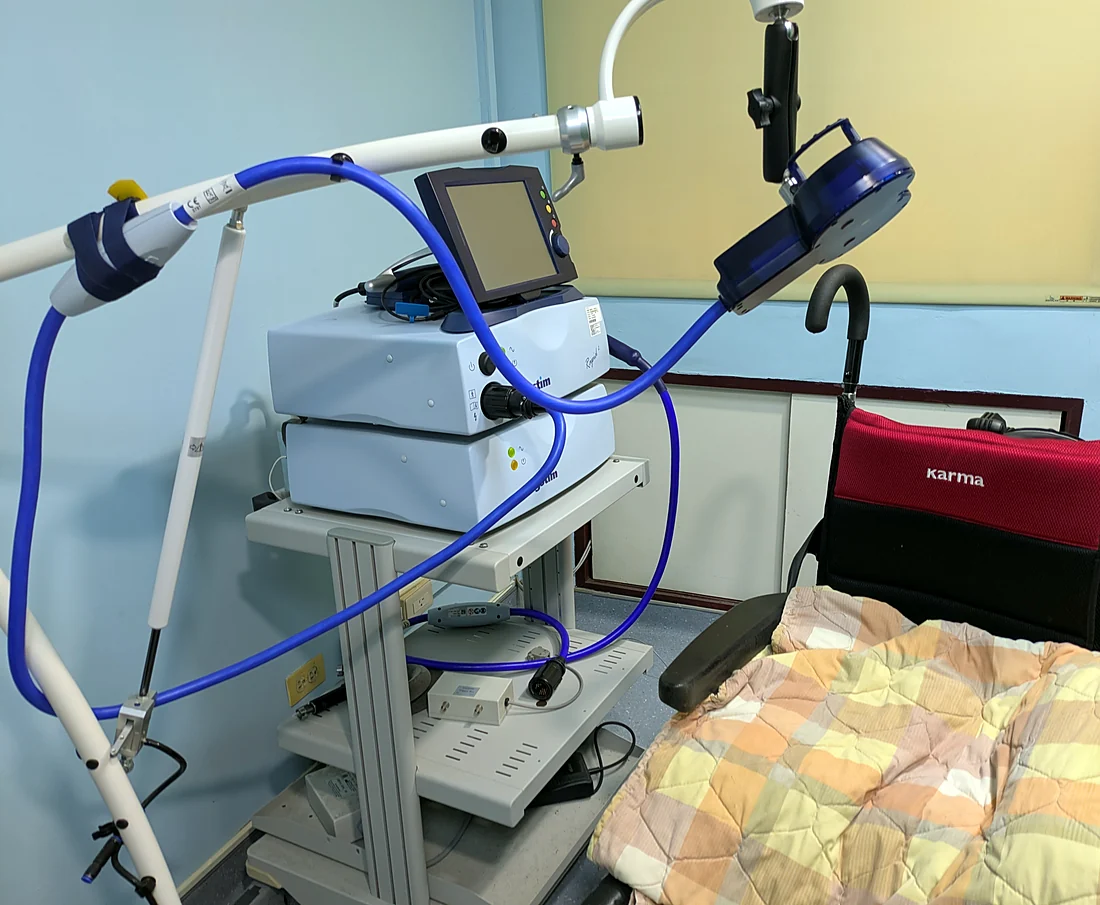
Photographed in this hospital’s treatment room.
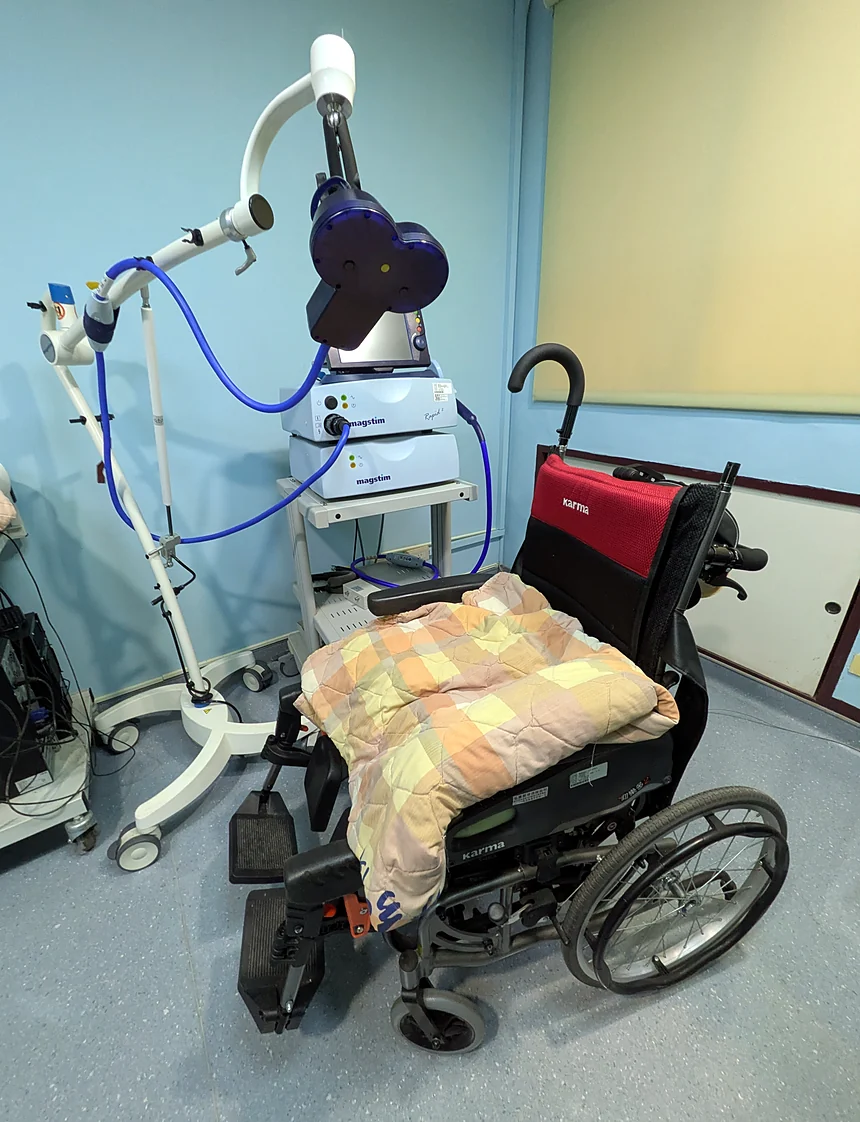
Photographed in this hospital’s treatment room.
rTMS is not there to replace antidepressants. In most cases it is added on top of the treatment you already have, and whether the drugs are adjusted is for the psychiatrist to decide — please do not stop your medication on your own account because you have started rTMS.
Contraindications and safety
Absolute contraindication
A ferromagnetic metal or electronic implant in the head or neck that cannot be removed — an aneurysm clip, a cochlear implant, a deep brain stimulator, a vagus nerve stimulator, an intracranial electrode or a metal fragment, for example. The magnetic field may move it, heat it or make it fail.
(Braces, dental implants and titanium plates in the skull are usually not a problem, but you must tell the team beforehand so that they can confirm it.)
- A history of epilepsy, or a family history of epilepsy: the most serious risk of rTMS is of inducing a seizure. Anyone with such a history needs to be assessed jointly with a neurologist.
- Severe head injury, brain surgery, a stroke lesion, or an intracranial tumour: these need assessing individually.
- Currently taking a drug that lowers the seizure threshold (some antidepressants, antipsychotics, lithium, theophylline, tramadol), or being in a state of alcohol or sedative withdrawal.
- Severe sleep deprivation: do make sure you sleep properly the night before treatment — staying up late raises the risk of a seizure.
- A pacemaker or an implantable defibrillator: although these are not in the head, the model and the distance from the coil still need to be confirmed.
- Pregnancy: the data are limited, and the usual advice is for a doctor to weigh it up individually.
Side effects
- Headache: the commonest, usually mild and settling within a few hours; an ordinary painkiller deals with it.
- Discomfort of the scalp at the site treated, and twitching of the facial muscles: these happen during treatment and stop when it ends.
- The noise of the machine: ear plugs are provided, to avoid any effect on hearing.
- Seizure: the most serious but extremely rare — according to the information from Taipei Veterans General Hospital, the chance is less than one in ten thousand.
- A switch into mania: there is a theoretical risk of triggering mania in someone with bipolar affective disorder, so that history has to be given beforehand.
Common questions
Is this the same as “electric shock treatment” (electroconvulsive therapy, ECT)?
Completely different. ECT needs a general anaesthetic and deliberately induces a seizure; it works powerfully but has side effects such as an effect on memory, and is generally used in extremely severe or dangerous cases. rTMS is an outpatient treatment given awake, without an anaesthetic, and without inducing a seizure, and you can leave as soon as it is done. The two are not in the same class in their intensity, the situations they suit, or their side effects.
Does it hurt?
Most people describe it as “the scalp being tapped lightly and regularly”. The first few sessions may feel more sensitive, and then you get used to it. A proportion of people get a mild headache after treatment, which an ordinary painkiller will deal with. If the site being stimulated is too sore, you can tell the operator to adjust the position of the coil or the intensity.
Can I stop my medication once I have finished?
No, and it is not a decision to make by yourself. rTMS is most of the time an option added on top of drug treatment. Whether and when the dose is reduced must be judged by the psychiatrist according to the clinical situation. Stopping suddenly can cause withdrawal effects and a rebound of the illness.
How long does the effect last? Will it come back?
After the acute course has finished, the effect may last several months. Some people will later need maintenance treatment (top-up sessions at longer intervals). Depression is in itself an illness that readily recurs, and continuing with medication, psychological therapy and changes to the way you live remain necessary.
I am just under a lot of stress and get tired easily. Can I have it to “look after my brain”?
There is at present no evidence supporting rTMS for boosting brainpower, enhancing memory or anti-ageing in healthy people. The depression to which Level A applies means clinically diagnosed major depressive disorder. If you feel persistently tired and low, the more sensible first step is to have a proper assessment — it might be depression, sleep apnoea, a thyroid problem or anaemia, all of which have clear treatments.
Does the NHI cover it?
At present it is entirely self-paid. The number of sessions and the cost differ between institutions, so check directly with the hospital where you are seen. Before starting, it is worth asking plainly: how many sessions in all, how much in total, and what happens if it has not worked part-way through.
References
- Lefaucheur JP, Aleman A, Baeken C, et al. Evidence-based guidelines on the therapeutic use of repetitive transcranial magnetic stimulation (rTMS): an update (2014-2018). Clin Neurophysiol. 2020;131(2):474-528.
- Consensus review and considerations on TMS to treat depression: a comprehensive update endorsed by the National Network of Depression Centers, the Clinical TMS Society, and the IFCN. Clin Neurophysiol. 2025.
- Blumberger DM, Vila-Rodriguez F, Thorpe KE, et al. Effectiveness of theta burst versus high-frequency repetitive transcranial magnetic stimulation in patients with depression (THREE-D): a randomised non-inferiority trial. Lancet. 2018;391(10131):1683-1692.
- 臺北榮民總醫院精神醫學部. 重覆經顱磁刺激(rTMS)治療常見問答. Available from: https://wd.vghtpe.gov.tw
References follow the ICMJE (Vancouver) style. Guidelines and official documents are given with their version or year of publication; legislation and National Health Insurance (NHI) rules are given with the responsible authority and the version date. Last checked: 8 October 2026.
Service information at this hospital
What follows is the usual arrangement. The number of sessions and the time per session are the ranges commonly seen in practice, not a promise to any individual patient; the indication, the number of sessions and the cost that actually apply to you depend on assessment in the outpatient clinic and on this hospital’s latest announcements.
- Where it is done
- The treatment room of the department of internal medicine; the indication is assessed by a psychiatrist or a neurologist
- Hours
- Weekdays 08:30–16:30
- Time per session
- Depending on the stimulation pattern, about 20–40 minutes (theta burst mode is shorter)
- Suggested number of sessions
- The standard course for depression is about 20–30 sessions, usually once a day on weekdays for four to six weeks running.
- Cost and coverage
- For the indications approved in Taiwan, please confirm the conditions of coverage in the clinic; everything else is self-paid. Please ask about the actual cost in the clinic.
- How to book
- The indication and the safety have to be assessed by a psychiatrist or a neurologist first, and the course is then arranged.
- Preparing for treatment
- You must tell us beforehand about: metal or electronic implants in the head or neck, a personal or family history of epilepsy, head injury or brain surgery, and any drug you are taking that lowers the seizure threshold. On the day, your normal routine is fine and you do not need to fast.
- Contact
- Taipei Veterans General Hospital Hsinchu Branch 03-596-2134 (ask for the treatment unit)
This content is health information. It is for reference only and cannot replace a professional medical diagnosis. Whether this treatment is right for you, and how a course should be arranged, must be decided by a doctor after assessing your individual situation. All of the working behind the interactive tools on this page is done on your own device; your answers are not uploaded and are not stored. This site records only anonymous usage statistics (for example, how many people read this page to the end, how many complete a self-assessment, and which band the result falls into). It does not include what you answered, and it sets no cookies. See the privacy notice for details.
Still have questions? Add Dr. Hwa-Yen Chiu’s LINE official account @chiubreath for clinic news and updates on respiratory health.
Add on LINE