
Latent tuberculosis infection (LTBI): defusing the unexploded bomb inside you
Division of Pulmonary Medicine, Taipei Veterans General Hospital Hsinchu Branch · Latent tuberculosis health information
For healthcare professionalsClinical pathway: choosing an LTBI regimen and working out the course (中文)
Mr. Wang arrived at the clinic looking thoroughly alarmed, report in hand. A family member he lives with had recently been diagnosed with pulmonary tuberculosis, and the public health bureau had told him that as a close contact he had to have a blood test — which had come back IGRA (interferon-gamma release assay) positive. He had barely sat down before the questions came: “Dr. Chiu, have I got tuberculosis too? Will I infect my colleagues? Do I have to be isolated?”
Dr. Chiu settled him down. “Take a deep breath first. Your chest X-ray is completely clear and entirely normal, which means the TB bacteria have simply been held down by your immune system and are ‘hibernating’ inside you. That is called latent tuberculosis infection (LTBI). As you are now, you have no symptoms, and you cannot infect anybody.” To clear the bacteria out while they were still dormant, the two of them discussed the options and decided on the widely used short-course regimen (3HP) — one dose a week, 12 doses in all (about 3 months). In the first few weeks on treatment he had chills, a slight fever and aching muscles, rather like a bad cold; once a blood test had confirmed his liver was coping, Dr. Chiu explained that these are the familiar “flu-like side effects” of 3HP. By the time he reached dose 6 his body had adjusted completely and the symptoms had vanished. Last week he happily swallowed his twelfth dose and “graduated” from the course, with the unexploded bomb safely defused. 🎉
What is latent tuberculosis infection?
Picture the TB bacteria as a group of uninvited guests who get into the body, and the immune system as a strong police force that at once “arrests them and locks them up”. The bacteria then enter a “hibernating, dormant” state, and that is what is called latent tuberculosis infection (LTBI).
Three reassurances about latent tuberculosis
✔ No symptoms ✔ Not infectious ✔ A normal chest X-ray
Nothing is wrong for now, but these dormant bacteria are like an unexploded bomb. If your immunity drops in the future — with age, with illness, under heavy stress, or because you are taking an immunosuppressant — the bacteria may wake up and develop into “active tuberculosis”, which is both infectious and destructive. Over a lifetime the chance of this happening is about 5–10%[3].
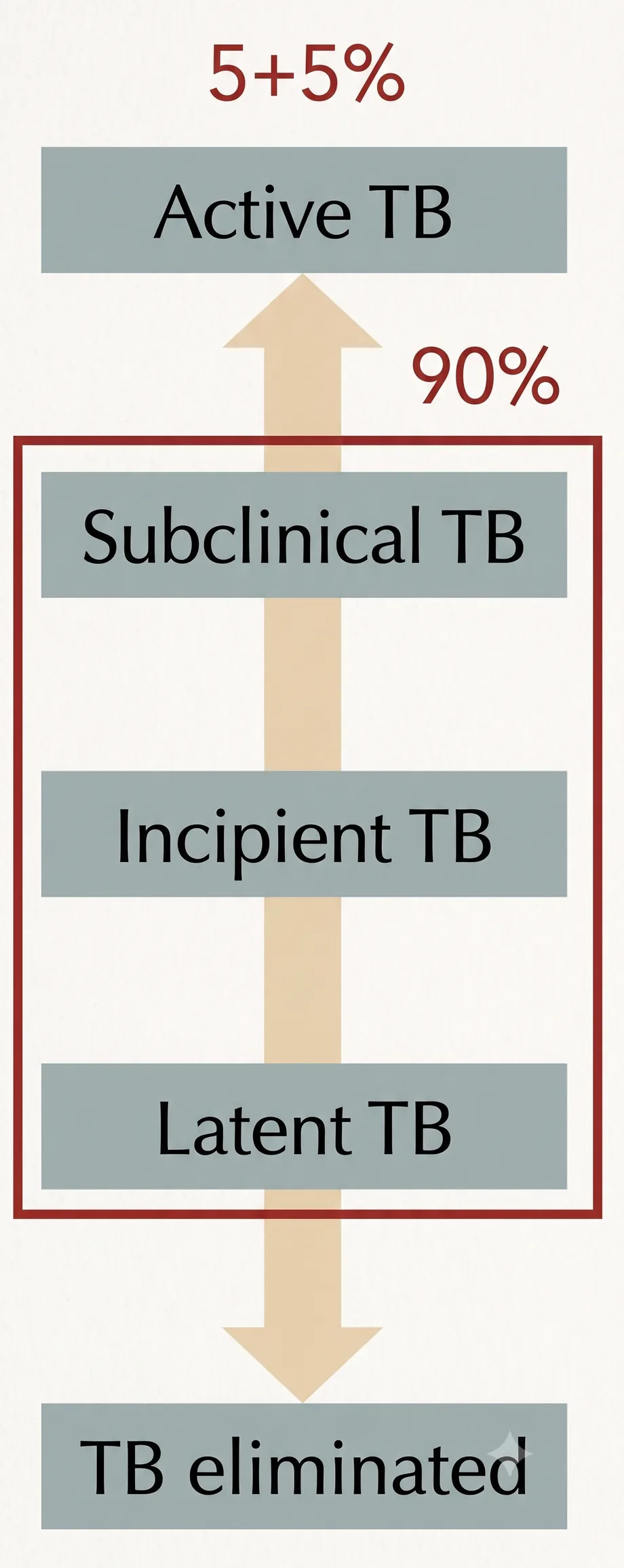
Latent tuberculosis vs. active pulmonary tuberculosis
| Feature | Latent tuberculosis infection (latent TB) | Active pulmonary tuberculosis (active TB) |
|---|---|---|
| State of the bacteria | Dormant, kept under control | Actively multiplying and destroying lung tissue |
| Clinical symptoms | Entirely without symptoms | A cough lasting more than two weeks, fever, night sweats, weight loss |
| Infectiousness | Not infectious | Highly infectious (spread by droplets) |
| Chest X-ray | Normal | Abnormal (shadowing, cavitation or infiltrates) |
| Sputum testing | No TB bacteria found (negative) | TB bacteria can be detected (positive) |
| Aim of treatment | “Pulling up the weeds by the root” — preventing the disease | “Curing the disease” |
Why treat it?
While the bacteria are still “dormant and few in number”, a few months of antibiotics can effectively cut the future risk of developing the disease by as much as 90%[1,2]. That not only protects your own lungs from future damage, it protects the family and friends closest to you, well in advance.
The preventive treatment regimens in common use
Several regimens are available in Taiwan at present. The short-course 3HP (high-dose isoniazid combined with rifapentine, once a week for 12 doses in all) has become widely used because the course is short and the completion rate high[1,2]; the traditional alternative is 9 months of daily isoniazid (9H).
- 3HP (once a week, 12 doses in all): a high completion rate, and markedly less liver toxicity than 9H. Strong evidence Government-funded
- 1HP (daily, 28 doses in all): the shortest course; suitable from the age of 13. Strong evidence Government-funded
- 4R (daily rifampin, 4 months): low liver toxicity, and can be used in pregnancy. Strong evidence
- 9H (daily isoniazid, 9 months): the traditional regimen — the longest course, and more liver toxicity. Strong evidence
For the full choice of regimen, the doses and the calculation of the deadline for completing treatment, you can use the LTBI tool in the clinical pathways section (中文).
- If you feel unwell, seek medical attention at once.
- Never stop the medicines on your own, in case drug-resistant TB bacteria emerge and treatment becomes very much harder.
- Every side effect should be discussed with your medical team, who will then assess what to do about it.
Prevention early beats treatment later. Let us defuse that unexploded bomb inside you, safely.

The original health education leaflet
You can view it online or download the A4 version to print and share.
References
- 衛生福利部疾病管制署. 結核病診治指引第七版第十章「潛伏結核感染」. 臺北:疾病管制署. Available from: https://www.cdc.gov.tw [In English: Taiwan Centers for Disease Control, Ministry of Health and Welfare. Taiwan guidelines for tuberculosis diagnosis and treatment, 7th edition, chapter 10, “Latent tuberculosis infection”. Taipei: Taiwan Centers for Disease Control.]
- Sterling TR, Villarino ME, Borisov AS, et al. Three months of rifapentine and isoniazid for latent tuberculosis infection. N Engl J Med. 2011;365(23):2155-2166.
- World Health Organization. WHO consolidated guidelines on tuberculosis. Module 1: prevention — tuberculosis preventive treatment. Geneva: WHO; 2020.
References follow the ICMJE (Vancouver) style. Guidelines and official documents are given with their version or year of publication; legislation and National Health Insurance (NHI) rules are given with the responsible authority and the version date. Last checked: 8 October 2026.
This content is health information. It is for reference only and cannot replace a professional medical diagnosis. For the actual testing and prescribing, please consult a qualified physician. This site records only anonymous usage statistics (for example, how many people read a page to the end, how many complete a self-assessment, and which band the result falls into). It does not record what you answered, and it sets no cookies. See the privacy notice for details.
Still have questions? Add Dr. Hwa-Yen Chiu’s LINE official account @chiubreath for clinic news and updates on respiratory health.
Add on LINE