
Pulmonary fibrosis: chronic scarring of the lung tissue
Division of Pulmonary Medicine, Taipei Veterans General Hospital Hsinchu Branch · Pulmonary fibrosis health information
For healthcare professionalsClinical pathway: interstitial lung disease medication (中文)
Mr. Lin is 55 and a retired accountant. A few years ago he began to notice that in the cold his fingers would turn pale, then purple, then red again — the classic Raynaud’s phenomenon. He thought nothing of it at first, but his skin slowly became tight and dry, especially on his fingers and face, and he was eventually diagnosed with systemic sclerosis.
Over the past year he had become breathless, developed a dry cough and tired easily. He put it down to a cold at first, but the symptoms kept getting worse. At a routine check-up his doctor heard an abnormal sound over his lungs and suggested looking further. A high-resolution computed tomography (HRCT) scan and lung function testing confirmed pulmonary fibrosis related to his systemic sclerosis. His doctor explained that systemic sclerosis is an autoimmune disease that affects the skin and the internal organs; in the lungs it causes chronic inflammation and fibrosis, so that the lung tissue stiffens, loses its elasticity and no longer works as well for breathing. He was set up with immunomodulating medicines, pulmonary rehabilitation and oxygen therapy, with regular lung function tests and HRCT scans to keep track of how things were going.
Key points on this page
- Pulmonary fibrosis is scarring of the lung tissue; the parts that have already scarred will not recover, and the aim of treatment is to slow down how fast things get worse.
- Diagnosis rests on high-resolution computed tomography (HRCT) plus lung function testing (FVC, DLCO), and needs several specialties reading it together. In Taiwan, HRCT is a second-line investigation that the National Health Insurance (NHI) covers conditionally.
- Once the diagnosis is made, it is essential to look for any coexisting autoimmune disease — that changes the choice of medicine considerably.
- The antifibrotic drugs (pirfenidone, nintedanib) have specific NHI application conditions (drug reimbursement rules, section 6.2.7), covering the extent of fibrosis on HRCT and the lung function values.
- A dry cough, getting more and more breathless on exertion, and fingertips that have become broader (clubbing) is a combination worth seeing a doctor about early.
What is pulmonary fibrosis?
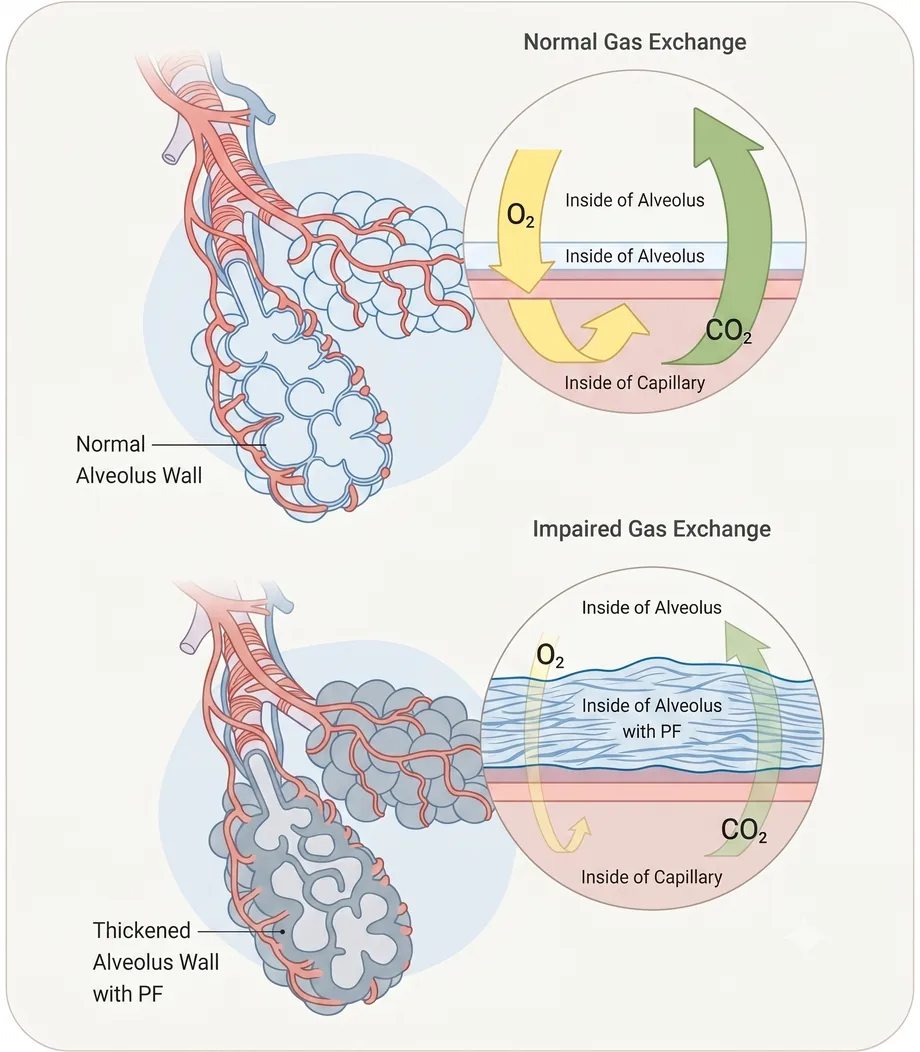
Pulmonary fibrosis is a chronic, progressive lung disease. Its hallmark is that the lung tissue becomes abnormally thickened and stiff and forms scars (fibrosis), so that lung function falls and breathing becomes difficult. The causes are varied, and include autoimmune disease (such as systemic sclerosis), environmental factors and medicines, as well as idiopathic pulmonary fibrosis (IPF), where no cause is found.
Because the lung interstitium becomes inflamed and thickened and gas exchange worsens, it causes breathlessness, a dry cough, tiring easily, clubbing of the fingers (the fingertips become broader and rounder) and chest tightness. Since this is chronic inflammation in the lungs, lung cancer also has to be watched for. After the diagnosis, the most important thing is to look for any coexisting autoimmune disease, because that has a large bearing on which medicines are chosen afterwards.
Diagnosis and follow-up
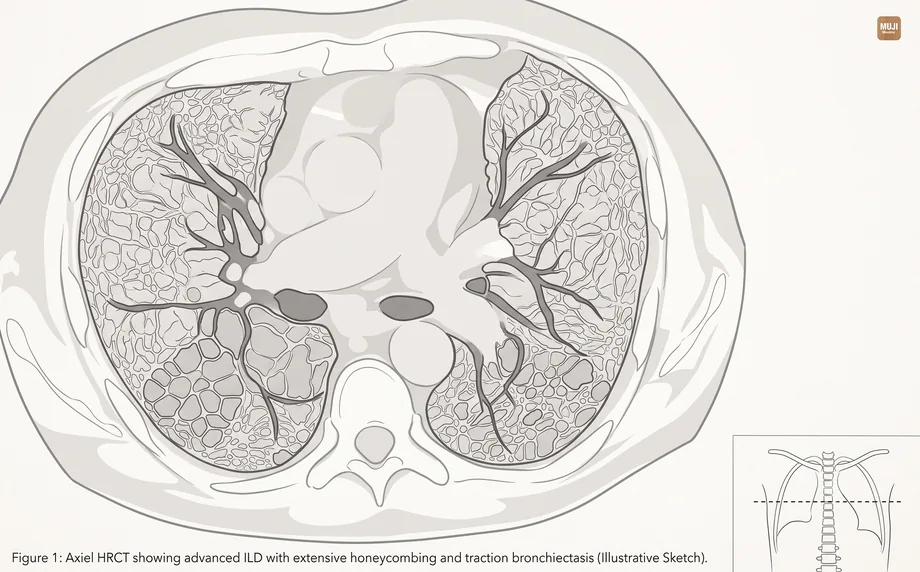
- High-resolution computed tomography (HRCT): assesses how extensive the fibrosis is and where it is, and is the key imaging test.
In Taiwan, HRCT is a second-line investigation that the National Health Insurance (NHI) covers conditionally — the doctor has to record in the notes and on the application form the clinical diagnosis, the purpose of the scan and the results of the basic tests already done (such as a chest X-ray and lung function testing). It is not something a patient can ask to have done on their own initiative. - Lung function testing: measures lung volume (FVC), gas transfer (DLCO) and airflow rates, and is an important way of tracking how the disease changes.
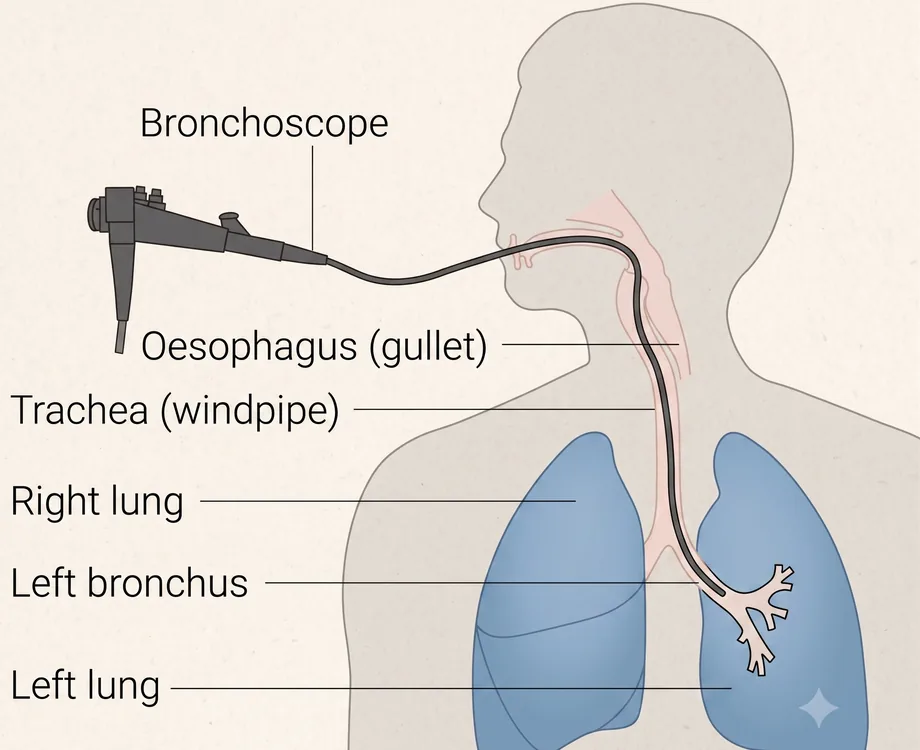
- Bronchoalveolar lavage (BAL): collects a sample of cells from the lung, which helps rule other diseases out.
- Lung biopsy: in certain situations a tissue biopsy is needed to settle the diagnosis.
Treatment and goals
| Treatment | What it is | Evidence |
|---|---|---|
| Antifibrotic drugs | Pirfenidone[2] and nintedanib[3], which can slow the progression of pulmonary fibrosis (the fall in FVC) | Strong evidence Conditions apply |
| Immunomodulating medicines | Immunosuppressants are used for pulmonary fibrosis related to autoimmune disease (such as systemic sclerosis); nintedanib is also suitable for systemic sclerosis-associated ILD[4] | Moderate |
| Corticosteroids | Used in certain situations to reduce inflammation; not recommended in idiopathic pulmonary fibrosis (IPF) | Limited |
| Oxygen therapy | Provides extra oxygen for people who are severely breathless | Moderate |
| Pulmonary rehabilitation | Breathing training, exercise training and education, to build up strength and improve how well you breathe | Strong evidence |
| Lung transplantation | Can be considered for people with severe disease who meet the criteria | Strong evidence |
Antifibrotic drugs cannot reverse scars that have already formed, but several phase 3 trials have confirmed that they can slow the rate at which lung function (FVC) falls. The aim is to hold the disease back and keep quality of life[1–4].
When to seek help immediately
Warning signs of an acute exacerbation
Interstitial lung disease can flare into an acute exacerbation, and the mortality of that is not low. If any of the following happens, seek medical help immediately:
- Your breathlessness has become clearly worse within a month (for example, you could walk 500 metres before and now have to stop after 100)
- A new fever together with worsening breathlessness
- Breathless even at rest, with a falling blood oxygen level
- Your lips or fingernails turn purple
- Chest pain together with a sudden onset of breathlessness — a pneumothorax and a pulmonary embolism have to be ruled out
Follow-up while things are stable matters just as much: a fall in FVC or DLCO often shows up earlier than any symptom you would notice yourself, and it is also one of the things the NHI uses to decide that the disease is progressing.
Common questions
Will my pulmonary fibrosis get better?
Lung tissue that has already scarred does not turn back into normal lung. But that does not mean there is nothing to be done — antifibrotic drugs have been shown to slow the rate at which FVC falls, and if yours is one of the autoimmune-related types, bringing the underlying immune disease under control can allow things to settle. That is why diagnosing it early, finding the cause and starting treatment early are what matter most.
Why does my doctor want so many blood tests?
Because one large group of interstitial lung diseases is caused by autoimmune disease (rheumatoid arthritis, systemic sclerosis, myositis and others), and this group is treated in a completely different direction from idiopathic pulmonary fibrosis — the first may need immunomodulating treatment, while the second is treated mainly with antifibrotic drugs. The blood tests are there to settle that question before any medicine is started; they are not extra tests for their own sake.
Are antifibrotic drugs covered by the NHI?
Yes, but the conditions are specific. Section 6.2.7 of the National Health Insurance (NHI) drug reimbursement rules sets out three separate routes — for idiopathic pulmonary fibrosis (IPF), for systemic sclerosis-associated ILD and for progressive fibrosing ILD (PF-ILD) — and each one requires the HRCT images and report, the extent of fibrosis, and the FVC and DLCO values to be submitted, with a periodic reapplication. You can check them line by line with the interstitial lung disease clinical pathway (中文).
Will I need oxygen?
When your blood oxygen is clearly low at rest or on exertion, supplementary oxygen can improve how much you can do and your quality of life. Many people resist oxygen because they feel that using it means they must be very ill — but in practice, using oxygen when it is needed is what keeps people active, and stops fitness falling away quickly because they are afraid to move.
Can I exercise?
You can, and pulmonary rehabilitation has been shown to improve exercise tolerance and quality of life. What matters is that the intensity is individualised and that your blood oxygen is monitored while you exercise — a fall in blood oxygen on exertion is particularly common in interstitial lung disease, and it can be completely normal at rest. Please have it arranged after an assessment by your doctor or a rehabilitation therapist.

The original health education leaflet
You can view it online or download the A4 version to print and share.
References
- Raghu G, Remy-Jardin M, Richeldi L, et al. Idiopathic pulmonary fibrosis (an update) and progressive pulmonary fibrosis in adults: an official ATS/ERS/JRS/ALAT clinical practice guideline. Am J Respir Crit Care Med. 2022;205(9):e18-e47.
- King TE Jr, Bradford WZ, Castro-Bernardini S, et al. A phase 3 trial of pirfenidone in patients with idiopathic pulmonary fibrosis (ASCEND). N Engl J Med. 2014;370(22):2083-2092.
- Richeldi L, du Bois RM, Raghu G, et al. Efficacy and safety of nintedanib in idiopathic pulmonary fibrosis (INPULSIS). N Engl J Med. 2014;370(22):2071-2082.
- Distler O, Highland KB, Gahlemann M, et al. Nintedanib for systemic sclerosis-associated interstitial lung disease (SENSCIS). N Engl J Med. 2019;380(26):2518-2528.
- 衛生福利部中央健康保險署. 全民健康保險藥品給付規定第 6.2.7 節(抗纖維化藥物). Available from: https://www.nhi.gov.tw [In English: Central National Health Insurance Administration, Ministry of Health and Welfare. National Health Insurance drug reimbursement rules, section 6.2.7 (antifibrotic drugs).]
References follow the ICMJE (Vancouver) style. Guidelines and official documents are given with their version or year of publication; legislation and National Health Insurance (NHI) rules are given with the responsible authority and the version date. Last checked: 8 October 2026.
This content is health information. It is for reference only and cannot replace a professional medical diagnosis. For an actual diagnosis and prescription, please consult a qualified physician. This site records only anonymous usage statistics (for example, how many people read a page to the end, how many complete a self-assessment, and which band the result falls into). It does not record what you answered, and it sets no cookies. See the privacy notice for details.
Still have questions? Add Dr. Hwa-Yen Chiu’s LINE official account @chiubreath for clinic news and updates on respiratory health.
Add on LINE