
Chronic obstructive pulmonary disease (COPD): airflow obstruction linked to tobacco harm
Division of Pulmonary Medicine, Taipei Veterans General Hospital Hsinchu Branch · COPD health information
For healthcare professionalsClinical pathway: COPD medication calculator (中文)
Mr. Lee is 68, a retired teacher, and had smoked for 40 years. Over the past few years he had begun to have a long-standing cough, to bring up phlegm and to get short of breath, especially after any activity. At first he put it down to age and being less fit than he was, but the symptoms kept getting worse, until they were affecting his daily life — tired, off his food, and out of breath after a few flights of stairs.
Last month, as his breathlessness worsened, he came to the chest medicine clinic, and a lung function test and a chest X-ray led to a diagnosis of chronic obstructive pulmonary disease (COPD). The doctor explained that years of smoking had damaged the structure of his lungs and obstructed the flow of air, and that this was why breathing had become difficult. He was set up with help to stop smoking, a bronchodilator and a pulmonary rehabilitation exercise programme; after a while, both his breathing and his quality of life were clearly better. It brought home to him how much stopping smoking mattered, and he threw himself into the rehabilitation in the hope of slowing the disease down.
Key points on this page
- The diagnosis always rests on lung function: a post-bronchodilator FEV1/FVC < 0.70. Symptoms or a chest X-ray alone cannot confirm it.
- Stopping smoking is the only measure clearly shown to slow the rate at which lung function declines — more important than any medicine.
- Maintenance treatment is built on long-acting bronchodilators (LABA plus LAMA), not on an inhaled corticosteroid.
- GOLD 2026 has lowered the risk threshold: after just one exacerbation in a year, the chance of having another is already clearly raised.
- Someone with COPD and a smoking history is also at high risk of lung cancer; the two have to be looked after together.
What is COPD?
Chronic obstructive pulmonary disease (COPD) is a common chronic lung disease that can be prevented and treated. Its main feature is persistent obstruction of the airways, which leads to difficulty breathing and to cough. COPD is usually linked to long-term exposure to air pollution or harmful gases, and the most common cause is smoking.
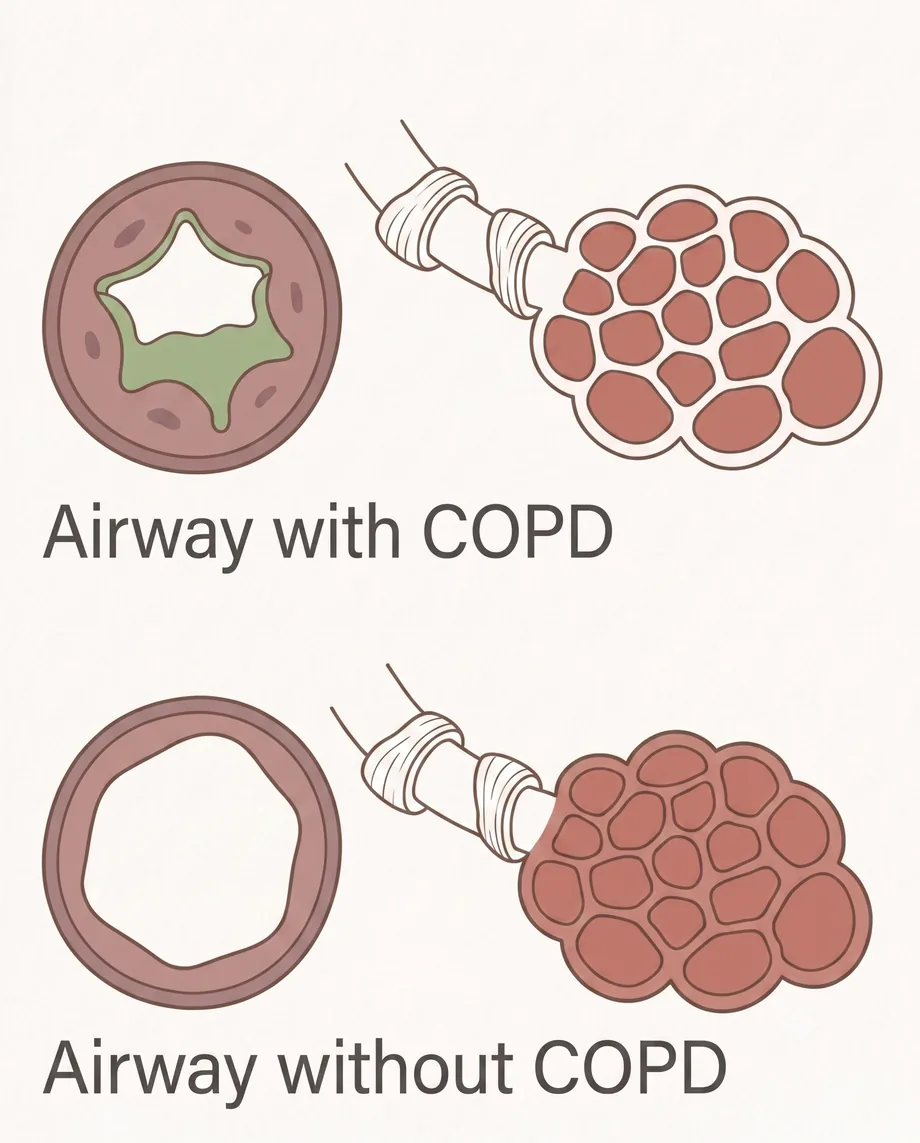
Inflamed airways thicken their smooth muscle and produce more mucus, so the airways narrow and resistance rises, and that in turn causes a chronic cough, phlegm, breathlessness on exertion, wheeze, chest tightness, fatigue and weight loss. On top of that, someone with COPD who has smoked or been exposed to air pollution also needs to be particularly watchful for lung cancer.
Diagnosis and follow-up
The most important thing in diagnosing COPD is lung function testing:
- Lung function testing (spirometry): detects airflow limitation, and is what the diagnosis rests on. Under GOLD 2026 the diagnosis is still made on a post-bronchodilator FEV1/FVC < 0.70[1].
- Chest X-ray: to assess emphysema, and to help pick up lung cancer early.
- Arterial blood gas analysis: to measure the oxygen and carbon dioxide in your blood.
- Blood eosinophil count (BEC): related to the type 2 immune response, and used to decide whether an inhaled corticosteroid should be used.
Treatment and goals
Stopping smoking — the most important treatment
Stopping smoking is the only measure clearly shown to slow the rate at which lung function declines, and it is the foundation of every other treatment. Strong evidence
Drug treatment
| Medicine | What it does | Evidence |
|---|---|---|
| Bronchodilators (LABA/LAMA) | Relax the muscle around the airways and improve airflow; the main maintenance treatment | Strong evidence |
| Inhaled corticosteroid (ICS) | Reduces airway inflammation and exacerbations; commonly used in people with a raised eosinophil count or repeated exacerbations | Strong evidence (in particular groups) |
| PDE4 inhibitor | Reduces inflammation in the lungs | Moderate |
| Antibiotics | Used to treat respiratory infection | Moderate (in exacerbations) |
GOLD 2026 restates that dual bronchodilation (LABA+LAMA) is the foundation of maintenance treatment, and that in people who keep having exacerbations despite dual bronchodilation, treatment is stepped up to a triple inhaler (ICS+LABA+LAMA)[1].
The main changes in GOLD 2026
- It looks at “disease activity”, not just the lung function number. GOLD 2026 describes COPD as a dynamic disease with inflammation, fluctuating symptoms and a risk of exacerbations, and the goal of treatment is to move the disease into a state of low activity, rather than to watch the FEV1 alone.
- A single exacerbation counts. The high-risk threshold used to be “≥ 2 moderate exacerbations, or 1 hospital admission, in a year”; GOLD 2026 points out that a single exacerbation on its own already clearly raises the chance of having another, and that risk assessment has to take the history, the symptoms and biomarkers together.
- Actively find the people who have it. It recommends systematic assessment of those at high risk (current or former smokers, unexplained breathlessness, a chronic cough or phlegm), and specifically notes that it can be picked up at the same time as lung cancer screening.
- Biologics formally enter COPD. In particular groups (eosinophilic, with features of chronic bronchitis), dupilumab and mepolizumab are listed as Level A evidence for reducing exacerbations and improving symptoms.
- Vaccination: a new recommendation for RSV vaccination from the age of 50; influenza and pneumococcal vaccination remain strongly recommended.
- Managing exacerbations: the severity classification and the criteria for deciding between outpatient and inpatient treatment have been updated, and high-flow nasal oxygen and non-invasive ventilation are included as supportive treatment options.
In Taiwan the National Health Insurance (NHI) coverage conditions for biologics in COPD differ from the guideline recommendations; what applies is as most recently published by the National Health Insurance Administration. You can check it against the COPD clinical pathway calculator (中文).
Non-drug treatment
Pulmonary rehabilitation Strong evidence Long-term oxygen therapy (only for chronic low blood oxygen) Strong evidence Surgery (lobectomy, lung volume reduction, lung transplantation) Moderate
Interactive version
If you want to know which GOLD group you are in, why your doctor has prescribed what they have, and what the NHI conditions for these inhalers are, you can use the interactive version:
COPD clinical pathway calculator (中文)— enter your mMRC/CAT score and the number of exacerbations you have had in the past year, and you will get your ABE group, a treatment recommendation, and your position marked with a red dot on the ABE diagram.
When to seek help immediately
Warning signs of an exacerbation
If a COPD exacerbation is dealt with too slowly, it can mean admission to hospital, or even intubation. If any of the following happens, get medical help straight away:
- So breathless that you cannot finish a sentence, or breathless even at rest
- Lips or fingernails turning blue
- Confusion, or unusual drowsiness — this may be a build-up of carbon dioxide, not simply being tired
- Phlegm that has become more copious, thicker or a different colour, together with a fever
- Obvious swelling of the legs, or a rapid rise in weight over a short time
- Coughing up blood
If you are only a little more breathless than usual, with slightly more phlegm, it is still worth coming back to clinic within a few days — an exacerbation that is treated earlier tends to recover more completely.
Common questions
I have already stopped smoking, so why is it still getting worse?
Stopping smoking cannot make lungs that are already damaged recover, but it can bring the rate at which your lung function declines back to something close to the slope of normal ageing. In other words, what stopping smoking changes is where you are heading, not where you have been. The earlier you stop, the more lung function you keep; and even once the diagnosis has been made, stopping smoking is still the single most effective thing you can do.
Will I have to use inhalers for the rest of my life?
The airway obstruction in COPD is persistent, so maintenance treatment is usually long term. But which inhalers you use, and whether an inhaled corticosteroid is added, is adjusted according to your symptoms, how many exacerbations you have had and your blood eosinophil count; it is not fixed for good. Plenty of people feel that their inhaler “does nothing” and stop it on their own, only to be admitted to hospital with an exacerbation a few months later — the value of maintenance treatment lies in having fewer attacks, not in how you feel in the moment after a dose.
Once I start using oxygen, will I never be able to stop?
Long-term oxygen therapy has clear conditions for its use (chronic low blood oxygen); it is not something you use simply because you are breathless. In the people who meet those conditions it is one of the few treatments shown to lengthen survival. It does not cause dependence — you need oxygen because your lungs can no longer keep your blood oxygen high enough, not because using oxygen made you that way.
Can you have COPD and asthma at the same time?
Yes, and it is not uncommon in practice. In that situation an inhaled corticosteroid matters more than it does in COPD alone. Your doctor will weigh up your history of allergy, your blood eosinophil count and how much your lung function improves after a bronchodilator. See Asthma for more.
Why does my doctor keep reminding me about vaccinations?
Because for someone with COPD, a single respiratory infection can set off an exacerbation, land you in hospital, and even leave your lung function never quite back to where it was. GOLD 2026 strongly recommends influenza and pneumococcal vaccination, and has added a recommendation for RSV vaccination from the age of 50. What is actually available in Taiwan, and the conditions for government funding, are as published by the responsible authorities.

The original health education leaflet
You can view it online or download the A4 version to print and share.
References
- Global Initiative for Chronic Obstructive Lung Disease. Global strategy for the diagnosis, management, and prevention of chronic obstructive pulmonary disease: 2026 report. GOLD; 2025. Available from: https://goldcopd.org/2026-gold-report/
- 衛生福利部國民健康署. 戒菸服務與肺阻塞(COPD)防治衛教資源. 臺北:國民健康署. Available from: https://www.hpa.gov.tw [In English: Health Promotion Administration, Ministry of Health and Welfare. Smoking cessation services and health education resources for the prevention of chronic obstructive pulmonary disease (COPD). Taipei: Health Promotion Administration.]
References follow the ICMJE (Vancouver) style. Guidelines and official documents are given with their version or year of publication; legislation and National Health Insurance (NHI) rules are given with the responsible authority and the version date. Last checked: 8 October 2026.
This content is health information. It is for reference only and cannot replace a professional medical diagnosis. For an actual diagnosis and prescription, please consult a qualified physician. This site records only anonymous usage statistics (for example, how many people read a page to the end, how many complete a self-assessment, and which band the result falls into). It does not record what you answered, and it sets no cookies. See the privacy notice for details.
Still have questions? Add Dr. Hwa-Yen Chiu’s LINE official account @chiubreath for clinic news and updates on respiratory health.
Add on LINE