
Asthma: the chronic inflammation behind recurring wheeze and cough
Division of Pulmonary Medicine, Taipei Veterans General Hospital Hsinchu Branch · Asthma health information
For healthcare professionalsClinical pathway: asthma medication calculator (中文)
Last month an unusual patient was referred in to Dr. Hwa-Yen Chiu’s clinic. Mr. Wang’s skin had been red and itchy for several months, and the dermatology department had diagnosed atopic dermatitis. But he had also noticed that at night and in the early morning he struggled to breathe, his chest felt tight and he coughed — worse after exercise or around dust — and sometimes he could hear himself wheezing. So his dermatologist suggested he come to the chest medicine clinic.
On examination there was a high-pitched wheeze over both lungs, his lung function test showed an obstructive ventilatory defect, and his exhaled nitric oxide (FeNO) was as high as 268 ppb. Dr. Chiu diagnosed asthma on the spot and started him on a two-in-one treatment: an inhaled corticosteroid combined with a bronchodilator. Because he also had atopic dermatitis and was in an acute attack, injected and oral steroids were added during the acute phase to settle things sooner. At his follow-up two weeks later the wheeze had gone and his symptoms were seventy or eighty per cent better; his angry red skin had returned to normal too (his face was just a little rounder). They then talked through how to taper the steroids.
Key points on this page
- Asthma is at heart chronic inflammation of the airways, not “a bit of breathlessness now and then”. Leave the inflammation alone and the airways become more and more sensitive.
- The core treatment is an inhaled corticosteroid (ICS). Using a short-acting bronchodilator (SABA) alone to relieve symptoms is something GINA now explicitly advises against.
- Normal lung function does not mean you do not have asthma — between attacks it can be completely normal, so it has to be read together with your symptoms, variable airflow limitation and markers of inflammation.
- A high FeNO points to allergic (type 2) inflammation, which usually responds better to inhaled corticosteroids; but a normal FeNO cannot rule asthma out.
- Biologics are available for severe asthma. Under Taiwan’s National Health Insurance (NHI) they require prior approval, and the conditions are quite specific.
What is asthma?
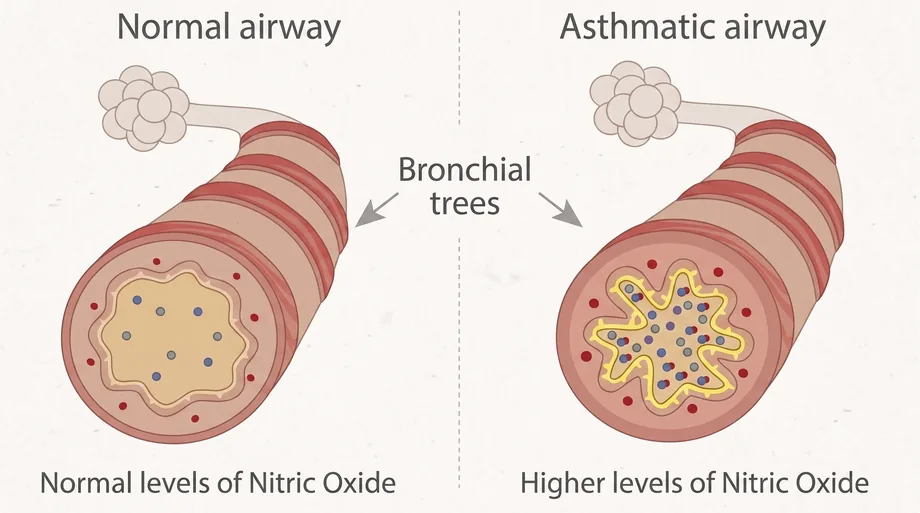
Asthma is a chronic inflammatory disease of the airways. Its features include airflow obstruction, bronchial hyperresponsiveness and inflammation. People usually have recurring wheeze, cough, chest tightness and difficulty breathing, more marked at night or in the early morning.
Inflamed airways narrow and produce more mucus, which raises the resistance to airflow and in turn causes laboured breathing, chest tightness and cough. Common coexisting conditions include the allergy-related ones — allergic rhinitis, nasal polyps, atopic dermatitis and urticaria — as well as obesity and depression.
Diagnosis and follow-up
Diagnosing asthma means putting the clinical symptoms together with several objective tests:
1. Lung function testing (spirometry)
This detects airflow limitation and bronchial hyperresponsiveness, and is the central tool in diagnosing asthma.

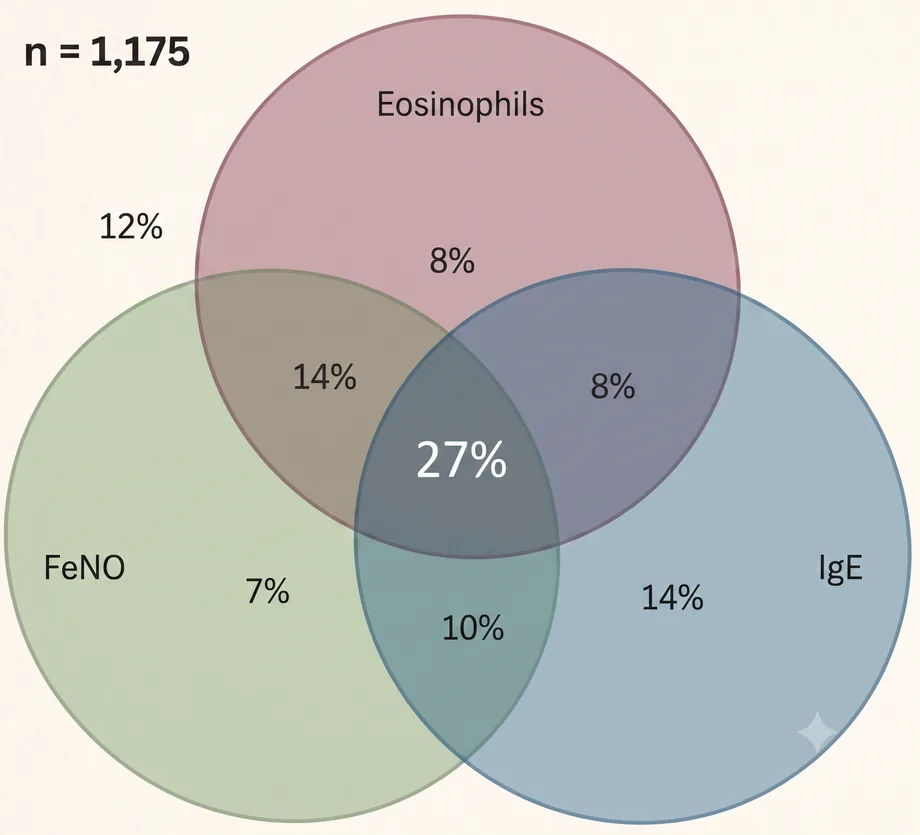
2. Markers of inflammation (several have to be used together)
- Blood eosinophil count (BEC): related to the type 2 immune response.
- Immunoglobulin E (IgE): the antibody in the blood associated with allergic responses.
- Fractional exhaled nitric oxide (FeNO): a marker that rises when the airways are inflamed. Under the ATS guideline, a FeNO ≥ 50 ppb in an adult strongly suggests eosinophilic (type 2) airway inflammation[2]. Mr. Wang’s 268 ppb in the story above is clearly high.
3. Symptom questionnaires
Several questionnaires are available as tools for long-term follow-up (for example the Asthma Control Test, ACT).
Treatment and goals
Under the international asthma guideline (GINA 2026)[1], asthma medicines fall into three broad groups: inhalers, oral medicines and biologics:
| Class | Typical medicines | Role | Evidence |
|---|---|---|---|
| Inhaled corticosteroid (ICS) | An ICS, or an ICS combined with a long-acting bronchodilator | Treats the cause: suppresses the inflammation; the single most important core medicine | Strong evidence |
| Bronchodilators | Short-acting / long-acting bronchodilators | Treats the symptom: short-term relief, but no anti-inflammatory effect | Strong evidence (for relief) |
| Biologics | Anti-IgE, anti-IL-5/IL-5R, anti-IL-4/13, anti-TSLP | Target the inflammatory pathway; used in severe, poorly controlled asthma | Strong evidence (severe asthma) Conditions apply |
Source: GINA, Global Strategy for Asthma Management and Prevention, 2026 (updated May 2026). The core principle has not changed — a short-acting bronchodilator (SABA) on its own is not recommended, and treatment for all adults and adolescents should be built on a regimen that contains an inhaled corticosteroid.
The main changes in GINA 2026
- The anti-inflammatory reliever (AIR) has moved forward to step 1. Step 1 of Track 2 now includes “an inhaled corticosteroid combined with a short-acting bronchodilator (ICS-SABA) as needed”, so that even the mildest asthma can have its inflammation treated at the same time as its symptoms are relieved.
- The diagnostic pathway has been simplified. GINA 2026 states plainly that the old diagnostic criteria led to under-diagnosis, particularly in young men, and has therefore simplified the diagnostic flow chart.
- Two new biologics: depemokimab (a long-acting anti-IL-5) and a generic anti-IgE; the decision tree for prescribing in severe asthma is also set out more clearly. A triple inhaler at step 5 reduces severe exacerbations by less than the biologics do, but it suits people who do not meet the conditions for a biologic.
- Children aged 6–11: ICS-formoterol has been added as an option alongside SABA for mild exacerbations, and a validated clinical score (PRAM) is recommended for assessing how severe an exacerbation is.
In Taiwan, National Health Insurance (NHI) coverage conditions and guideline recommendations are two different things. Every biologic requires prior approval; for the NHI checks, see the asthma clinical pathway calculator (中文).
The point of treatment
The inhaled corticosteroid that suppresses the inflammation treats the cause; a bronchodilator works well in the short term but only treats the symptom. Using your inhaler regularly, with the right inhaler technique, and keeping up long-term follow-up are what hold asthma steadily under control.
Interactive version
If you want to know how well your own asthma is controlled, which treatment step you are on, and what the NHI conditions for a biologic are, you can use the interactive version:
Asthma clinical pathway calculator (中文)— answer the four GINA control assessment questions and you will get your level of control, a Track and Step recommendation, and your position marked on the treatment step diagram.
When to seek help immediately
Warning signs of an acute asthma attack
An acute asthma attack can get worse within hours. If any of the following happens, go to a hospital or call an ambulance straight away — do not wait for a clinic appointment:
- You can only get a few words out before you have to take a breath, or cannot finish a sentence
- Your reliever inhaler makes no difference, or you need it again within three to four hours
- Your lips or fingernails turn blue, or you are confused or agitated
- You are so breathless that you have to sit up and cannot lie down, with a cold sweat
- Pressure in the chest at the same time, with a cold sweat — a heart problem has to be ruled out first
If your symptoms are milder but keep coming back (for example, needing your reliever inhaler more than twice a week, or waking at night because of asthma), you do not need the emergency department — but it does mean your asthma is not well controlled, and you should come back to clinic soon to have your medicines adjusted.
Common questions
Do inhaled corticosteroids have side effects? Will I become dependent on them?
An inhaled corticosteroid is breathed in and acts locally on the airways. The dose is a tiny fraction of an oral steroid dose, and the whole-body side effects (a moon face, osteoporosis, a rise in blood sugar) are not in the same league as with the oral form. The common local side effects are a hoarse voice and oral thrush, and rinsing your mouth after each dose usually prevents both. It does not cause addiction or dependence — if anything, what really leaves people unable to do without treatment is leaving the inflammation alone, so that the airways become more and more sensitive.
Will my asthma go away? Can I stop the medicines?
Asthma cannot currently be cured, but the great majority of people can control it well enough to live exactly as anyone else does. After at least three months of stable control your doctor will consider stepping the treatment down, but that has to be done after a medical assessment; stopping the medicines on your own is not advised — symptoms going away usually only means the inflammation has been suppressed, not that it has gone.
My lung function test was normal, so why does my doctor still say I have asthma?
This is very common. What characterises asthma is variable airflow limitation, and between attacks lung function can be completely normal. Your doctor will also look at the pattern of your symptoms (worse at night or in the early morning, brought on by cold air or by exercise), your FeNO, your blood eosinophil count and the day-to-day variation in your peak expiratory flow, and will arrange a bronchial challenge test if needed. For more on interpretation, see An abnormal lung function report.
What is the difference between asthma and chronic obstructive pulmonary disease (COPD)?
The crucial difference is whether the obstruction is reversible. In asthma the airflow obstruction usually improves markedly after a bronchodilator, and the symptoms often come in bouts; in COPD the obstruction is persistent, and closely linked to long-term smoking or exposure to air pollution. The two can also be present at the same time. See Chronic obstructive pulmonary disease (COPD) for more.
Can I exercise if I have asthma?
Yes, and you should. Regular exercise improves cardiorespiratory fitness and quality of life. If your symptoms are exercise-induced, what matters is getting the day-to-day inflammation under control, together with a thorough warm-up; your doctor may also suggest using a particular inhaler before you exercise. If exercise always leaves you breathless enough to need your reliever inhaler, your everyday control is not good enough and you should come back to clinic to have it adjusted.

The original health education leaflet
You can view it online or download the A4 version to print and share.
References
- Global Initiative for Asthma. Global strategy for asthma management and prevention. 2026 update. Fontana (WI): GINA; 2026. Available from: https://ginasthma.org/2026-gina-strategy-report/
- Dweik RA, Boggs PB, Erzurum SC, et al. An official ATS clinical practice guideline: interpretation of exhaled nitric oxide levels (FeNO) for clinical applications. Am J Respir Crit Care Med. 2011;184(5):602-615.
References follow the ICMJE (Vancouver) style. Guidelines and official documents are given with their version or year of publication; legislation and National Health Insurance (NHI) rules are given with the responsible authority and the version date. Last checked: 8 October 2026.
This content is health information. It is for reference only and cannot replace a professional medical diagnosis. For an actual diagnosis and prescription, please consult a qualified physician. This site records only anonymous usage statistics (for example, how many people read a page to the end, how many complete a self-assessment, and which band the result falls into). It does not record what you answered, and it sets no cookies. See the privacy notice for details.
Still have questions? Add Dr. Hwa-Yen Chiu’s LINE official account @chiubreath for clinic news and updates on respiratory health.
Add on LINE