
Obstructive sleep apnoea (OSA): sleep well and keep your blood oxygen steady, and your heart and brain will thank you
Division of Pulmonary Medicine, Taipei Veterans General Hospital Hsinchu Branch · OSA health information
An unusual patient turned up at Dr. Hwa-Yen Chiu’s clinic this week: an engineer in his fifties who had snored loudly for years, often woke with a dry mouth and a headache, kept nodding off in meetings during the day, and had recently been diagnosed with high blood pressure. Because of his shift pattern he chose to have a home sleep study, and the result was moderate sleep apnoea, with his blood oxygen dropping again and again overnight and a lowest oxygen saturation of only 80%.
After starting CPAP (continuous positive airway pressure) treatment, he was noticeably sharper during the day and his blood pressure was steadier too. His cardiologist also advised him to keep using it. A word from the doctor: if you or someone in your family has “loud snoring, daytime sleepiness, high blood pressure or heart disease”, do raise with your doctor whether a sleep study is needed.
Key points on this page
- Snoring is not the same thing as sleep apnoea, but “snoring plus being tired however much you sleep” is worth investigating.
- The diagnosis rests on a sleep study (a standard PSG or a home test). Questionnaires such as STOP-BANG and the Epworth scale can only screen; they cannot diagnose.
- CPAP clearly improves sleepiness, blood pressure and quality of life; on the question of reducing cardiovascular events in people who already have cardiovascular disease, the result of the large SAVE trial was neutral.
- Losing weight and avoiding alcohol and sedatives before bed are the basics that everyone should do first, whether or not CPAP is used.
- Being sleepy enough to doze off at the wheel is an immediate safety problem; please do not drive until it has been sorted out.
What is sleep apnoea?
Obstructive sleep apnoea (OSA) is a condition in which breathing repeatedly stops or becomes shallow during sleep, usually because the upper airway collapses. Through the night, the blood oxygen falls again and again (intermittent hypoxia) and the person is repeatedly forced briefly awake (fragmented sleep).
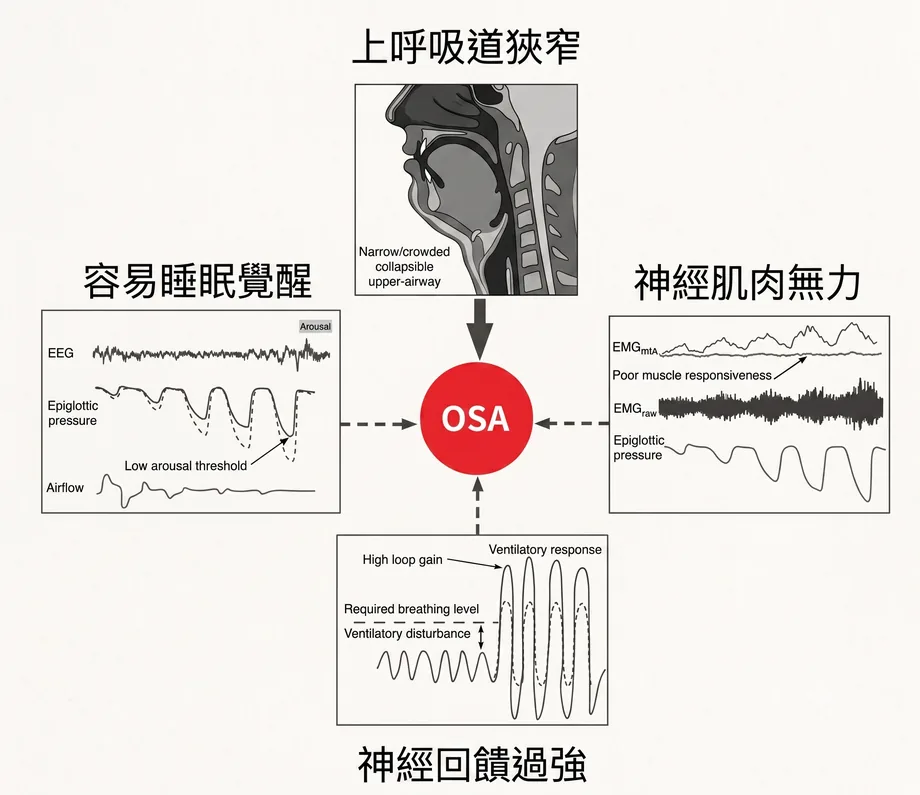
Left untreated over years, OSA raises the following risks, through repeated lack of oxygen and over-activity of the sympathetic nervous system: high blood pressure, irregular heart rhythms, coronary artery disease, heart attack, stroke, poorly controlled diabetes and metabolic syndrome; and, from the daytime sleepiness, road or workplace accidents, worse memory and mood disorders.
Diagnosis and follow-up
Diagnosing OSA requires an appropriate sleep study:
- Standard polysomnography (PSG): an overnight stay at a sleep centre, with a full recording of brain waves, airflow, blood oxygen, the electrocardiogram and more. This is the gold standard for diagnosis.
- Home sleep apnoea testing (HSAT): you wear a simple device in the familiar surroundings of your own home, and your breathing and blood oxygen during sleep are assessed. It suits people for whom an overnight stay is awkward because of shift work, and certain other groups.
- How sleepy you are during the day can be followed with questionnaires such as the Epworth Sleepiness Scale (ESS).
Which test is more suitable is best arranged by your doctor after assessing your symptoms and any other conditions you have. Tools for the reports are also available in this site’s “smart report system (中文)”.
Treatment and goals
The goal of treatment is to improve the lack of oxygen and the fragmentation of sleep. The usual approaches include:
- Continuous positive airway pressure (CPAP): currently the first-choice treatment for moderate to severe OSA, using a flow of air to hold the upper airway open. Strong evidence (improves symptoms)
- Losing weight: can markedly reduce the severity, and in some people even resolve it. Strong evidence
- Avoiding alcohol and sedatives before bed: both reduce the muscle tone of the upper airway. Strong evidence
- Training yourself to sleep on your side: suits the positional type, which is clearly worse when lying on the back. Moderate
- An oral anti-snoring device: suits mild to moderate disease, or people who cannot tolerate CPAP. Moderate
- Surgery: for those with a clear anatomical obstruction. Moderate
What the science shows about CPAP and cardiovascular risk
CPAP has clearly been shown to improve snoring, daytime sleepiness, blood pressure and quality of life. On the question of whether it reduces cardiovascular events in people who already have cardiovascular disease, the result of the large randomised SAVE trial was neutral (it did not reach statistical significance)[1], which is generally put down to the low number of hours a night that CPAP was used in the trial. The core value of CPAP therefore lies in improving symptoms and quality of life and in steadying blood pressure; whether it is used for cardiovascular risk management is something to discuss individually with your doctor.
When to seek help immediately
Situations that should not wait
Sleep apnoea is for the most part not an emergency, but the following should not wait:
- Dozing off while driving, riding or operating machinery — this is a risk of harming yourself and others, so stop driving and seek medical help as soon as you can
- Someone has witnessed your breathing stopping, together with chest pain, palpitations or an irregular heartbeat at night
- Waking in the morning with a headache together with a change in awareness, and feeling foggy all day
- You already have heart failure or chronic lung disease, or are taking opioid medicines, and abnormal breathing at night has appeared
- Overnight oxygen measurement shows repeated, marked falls
Common questions
I am not overweight — can I still have sleep apnoea?
Yes. Obesity is the most common risk factor, but it is not the only one. A set-back or small lower jaw, large tonsils or a bulky tongue base, a deviated nasal septum, an underactive thyroid, and simply getting older all make the upper airway more liable to collapse. The craniofacial structure of Asian populations means that a relatively high proportion of people of normal weight have the condition, so “not being overweight” cannot be used to rule it out.
What is the difference between a home test and spending a night in hospital?
A standard polysomnogram (PSG) records your brain waves, so it can tell how long you were genuinely asleep and which stage of sleep you were in. It is the gold standard for diagnosis, and it can also reveal central apnoea and other sleep disorders. A home sleep apnoea test (HSAT) is done in your own bed and is more convenient, and it suits people at moderate to high risk without serious heart or lung disease; its drawback is that it may underestimate how severe the condition is, so if the result is normal but the symptoms are clear, a PSG is still needed.
Will I be able to tolerate CPAP? Do I have to use it for the rest of my life?
The first and second weeks are what matter. Most problems with getting used to it (leaks, the feeling of pressure, a dry mouth, a blocked nose) have a corresponding solution: a different mask size or style, heated humidification, or a change to the pressure mode. Trouble adapting is usually a problem with the settings or the kit, not a problem of willpower, so come back to clinic to have it adjusted rather than giving up. If your weight comes down substantially later on, or you have effective surgery, the severity may change, and you can discuss being reassessed with your doctor then.
Can an anti-snoring device or surgery take the place of CPAP?
For people with mild to moderate disease, or those who cannot tolerate CPAP, an oral anti-snoring device is a reasonable alternative; surgery suits those with a clear anatomical obstruction (markedly enlarged tonsils, for example). But for moderate to severe OSA, CPAP remains the most reliable way of bringing the apnoea index down. Which one to choose depends on the severity, on where the obstruction is, and on how consistently you can actually keep using it.
Will treatment really bring my blood pressure down?
It will, but the size of the effect is usually modest, and it is more apparent in people whose blood pressure was poorly controlled to begin with, or who have resistant hypertension. CPAP is not a substitute for blood pressure medicines. A genuinely steady effect comes from using it every night and for long enough — the reason the SAVE trial was neutral on cardiovascular endpoints is generally put down to the low average number of hours a night that CPAP was used in the trial.

The original health education leaflet
You can view it online or download the A4 version to print and share.
References
- Kapur VK, Auckley DH, Chowdhuri S, et al. Clinical practice guideline for diagnostic testing for adult obstructive sleep apnea: an American Academy of Sleep Medicine clinical practice guideline. J Clin Sleep Med. 2017;13(3):479-504.
- Patil SP, Ayappa IA, Caples SM, et al. Treatment of adult obstructive sleep apnea with positive airway pressure: an American Academy of Sleep Medicine clinical practice guideline. J Clin Sleep Med. 2019;15(2):335-343.
- McEvoy RD, Antic NA, Heeley E, et al. CPAP for prevention of cardiovascular events in obstructive sleep apnea (SAVE). N Engl J Med. 2016;375(10):919-931.
References follow the ICMJE (Vancouver) style. Guidelines and official documents are given with their version or year of publication; legislation and National Health Insurance (NHI) rules are given with the responsible authority and the version date. Last checked: 8 October 2026.
This content is health information. It is for reference only and cannot replace a professional medical diagnosis. For actual tests and treatment, please consult a qualified physician. This site records only anonymous usage statistics (for example, how many people read a page to the end, how many complete a self-assessment, and which band the result falls into). It does not record what you answered, and it sets no cookies. See the privacy notice for details.
Still have questions? Add Dr. Hwa-Yen Chiu’s LINE official account @chiubreath for clinic news and updates on respiratory health.
Add on LINE