
Tuberculosis: found early and treated regularly, it can be cured
Division of Pulmonary Medicine, Taipei Veterans General Hospital Hsinchu Branch · Tuberculosis health information
For healthcare professionalsClinical pathway: anti-tuberculosis drug doses (中文)
Mr. Li is a taxi driver in his fifties. Over the past three months he had begun to cough on and off, with streaks of blood in his phlegm. He had put it down to a cold or to his smoking and bought medicines over the counter, but nothing improved — and he had quietly lost nearly 5 kg. At his family’s insistence he came to the chest medicine clinic here.
Listening to his chest, Dr. Chiu picked up slightly abnormal breath sounds, and the chest X-ray he arranged showed a typical cavitating lesion in the right upper zone, closely associated with pulmonary tuberculosis. To be safe he arranged sputum testing and a rapid TB PCR at once, and advised admission to a negative-pressure isolation room first. The report came back the next day: TB PCR positive — a confirmed diagnosis of infectious pulmonary tuberculosis. Dr. Chiu explained patiently: “Tuberculosis is not something to dread. As long as it is found early and the medicines are taken regularly, most patients recover completely.” He also helped set up the tuberculosis care card and the directly observed treatment (DOTS) programme. After six months of treatment Mr. Li’s lesion shrank steadily, three sputum cultures were negative and his symptoms had gone completely; he finished the course and was declared cured.
What is tuberculosis?
Tuberculosis (TB) is a chronic infectious disease caused by Mycobacterium tuberculosis. It is spread through the air, and long, close contact with a patient makes infection likely. It attacks the lungs most often (pulmonary tuberculosis), but it can involve other organs as well, and it presents in many different ways — so if there is any suspicion of it, see a doctor as soon as you can.
Common symptoms
A long-standing cough (> 2 weeks), coughing up phlegm / coughing up blood, fever, night sweats, weight loss, tiredness, loss of appetite, chest pain. Tuberculosis can be cured, as long as it is found early, the medicines are taken regularly and the course is completed.
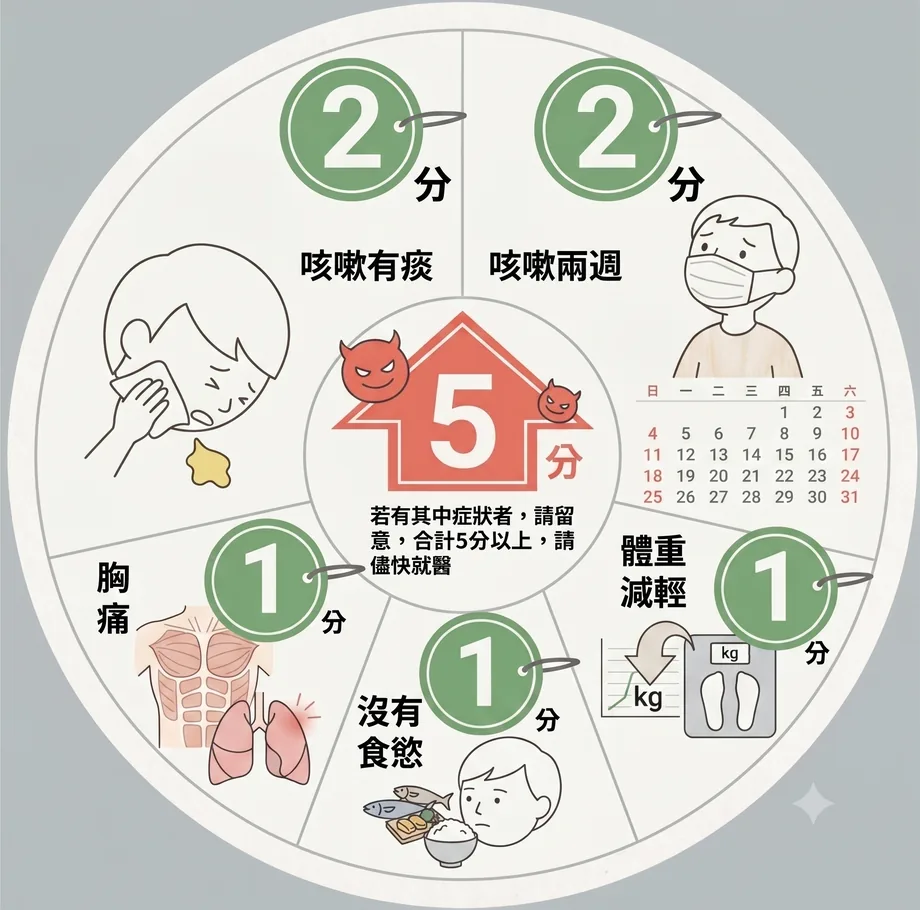
A patient’s rights and responsibilities
| Rights | Responsibilities |
|---|---|
| You hold a “tuberculosis care card”, which entitles you to a government subsidy and to treatment: free anti-tuberculosis medicines, health education from the medical and nursing team, and psychological support. | Co-operating with the “DOTS strategy”: a care worker watches you take your medicines each day; following your doctor’s instructions and taking the medicines regularly; wearing a mask when you cough, so as not to infect others. |

How it is treated, and the goal of treatment
The basic course: usually 6 months, divided into an intensive phase (2 months) and a continuation phase (4 months); in particular circumstances the medicines have to be taken for 9 to 12 months. Strong evidence (the standard course)
Taking the medicines under DOTS (directly observed treatment, short-course) markedly raises the proportion of people who complete treatment and lowers the chance of drug resistance emerging. Strong evidence
| Drug | Points to watch for |
|---|---|
| Isoniazid (INH) | Abnormal liver function; numbness of the hands and feet (vitamin B6 can be added) |
| Rifampin | Abnormal liver function; urine and other body fluids turn orange-red |
| Ethambutol | Blurred vision; effects on the optic nerve |
| Pyrazinamide | Abnormal liver function, joint pain, a rise in uric acid |
- If you develop jaundice, extreme tiredness, trouble with your vision, or stomach upset you cannot put up with, seek medical attention at once.
- Never stop the medicines on your own, in case drug-resistant TB bacteria emerge and treatment becomes very much harder.
- Every side effect should be discussed with your medical team, who will then assess what to do about it.
Tracing contacts
Close contacts (family members and others living in the same household, for example) need free testing: a chest X-ray, sputum testing, and a blood test for latent tuberculosis (IGRA). If latent tuberculosis infection is confirmed, preventive treatment can be considered — see the health information on “latent tuberculosis infection”.
Interactive version
Healthcare staff can use the interactive version to work doses out quickly:
Anti-tuberculosis drug dose calculator (中文)— enter the body weight and the serum creatinine, and it works out the doses of all four drugs (INH, RMP, PZA, EMB) and the actual number of tablets to take, adjusts the dosing frequency for renal function, and assesses whether vitamin B6 needs to be added.

The original health education leaflet
You can view it online or download the A4 version to print and share.
References
- 衛生福利部疾病管制署. 結核病診治指引(Taiwan guidelines for TB diagnosis and treatment)第七版. 臺北:疾病管制署. Available from: https://www.cdc.gov.tw [In English: Taiwan Centers for Disease Control, Ministry of Health and Welfare. Taiwan guidelines for tuberculosis diagnosis and treatment, 7th edition. Taipei: Taiwan Centers for Disease Control.]
- World Health Organization. WHO consolidated guidelines on tuberculosis. Module 4: treatment — drug-susceptible tuberculosis treatment. Geneva: WHO; 2022.
References follow the ICMJE (Vancouver) style. Guidelines and official documents are given with their version or year of publication; legislation and National Health Insurance (NHI) rules are given with the responsible authority and the version date. Last checked: 8 October 2026.
This content is health information. It is for reference only and cannot replace a professional medical diagnosis. For the actual diagnosis and prescribing, please consult a qualified physician. If you have symptoms that could be tuberculosis, seek medical attention early and get in touch with a chest medicine clinic or with your local public health bureau’s tuberculosis control unit. This site records only anonymous usage statistics (for example, how many people read a page to the end, how many complete a self-assessment, and which band the result falls into). It does not record what you answered, and it sets no cookies. See the privacy notice for details.
Still have questions? Add Dr. Hwa-Yen Chiu’s LINE official account @chiubreath for clinic news and updates on respiratory health.
Add on LINE